
Professional web design for NDIS providers
NDIS website design Australia, built for trust, access and real referrals
Accessible WordPress websites for registered NDIS providers, tailored for participants, families and support coordinators, then tested against WCAG 2.2 Level AA.
From $2,700 · One week build · Content included · You own the site
Live project · Blossom Care
Registered NDIS provider, verified on the NDIS Commission register
AA
WCAG 2.2 tested
7
NDIS website design and development for disability support providers
Your website has three readers and one chance with each. A participant needs to know you can help. A family member is checking whether you are real. A support coordinator is deciding, often in under a minute, whether to send someone your way.
NDIS website design is the work of answering all three on the same site, then proving the site can be used by the people you support. We build on WordPress, test against WCAG 2.2 Level AA, and hand you the report. From $2,700, live in a week. All prices are final, no GST is added., for providers anywhere in Australia.
That last part is where most web design projects stop short. Some of the people reading a disability service provider website cannot use a site built the ordinary way, and they are the people your registration under the National Disability Insurance Scheme exists to serve.
WCAG 2.2
Level AA test and written report
Written report
One week
Typical build and testing window
100% yours
WordPress, files and ownership
Three audiences · three questions
Connect with participants, families and support coordinators
PARTICIPANTS
Can you support me?
FAMILIES & CARERS
Can I trust you?
COORDINATORS
Can I refer today?
Coordinators read your site between appointments. They want two things: the supports you are registered to deliver, and whether you have room. If both are not obvious, they move to the next provider on the list.
So we build two enquiry paths. One general contact form asks a participant and a coordinator the same questions and serves neither well.
Compliance you can check yourself
What an auditor can see on your NDIS provider website
Most providers prepare for a registration audit by sorting files, policies and staff records. The website comes up anyway, because it is where you make claims about your services in public. Four compliance points tend to attract attention.
01
Registration is stated clearly
02
Complaints are easy to make
03
Claims match what you deliver
04
People can actually use it
05
Accessibility is the service
tested, not claimed
Accessible websites and NDIS compliance, tested by hand
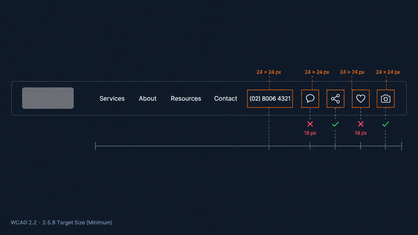
The standard is the Web Content Accessibility Guidelines, version 2.2, at Level AA. We reviewed the specialist NDIS agencies ranking in Australia. Of the ones that name a standard at all, every one names version 2.1. Version 2.2 added the criteria that matter on a phone: tap targets big enough to hit, focus a sticky header cannot cover, and forms that do not ask twice.
01 · Test report
02 · Accessibility statement
03 · A clear guarantee
04 · Two things we will not do
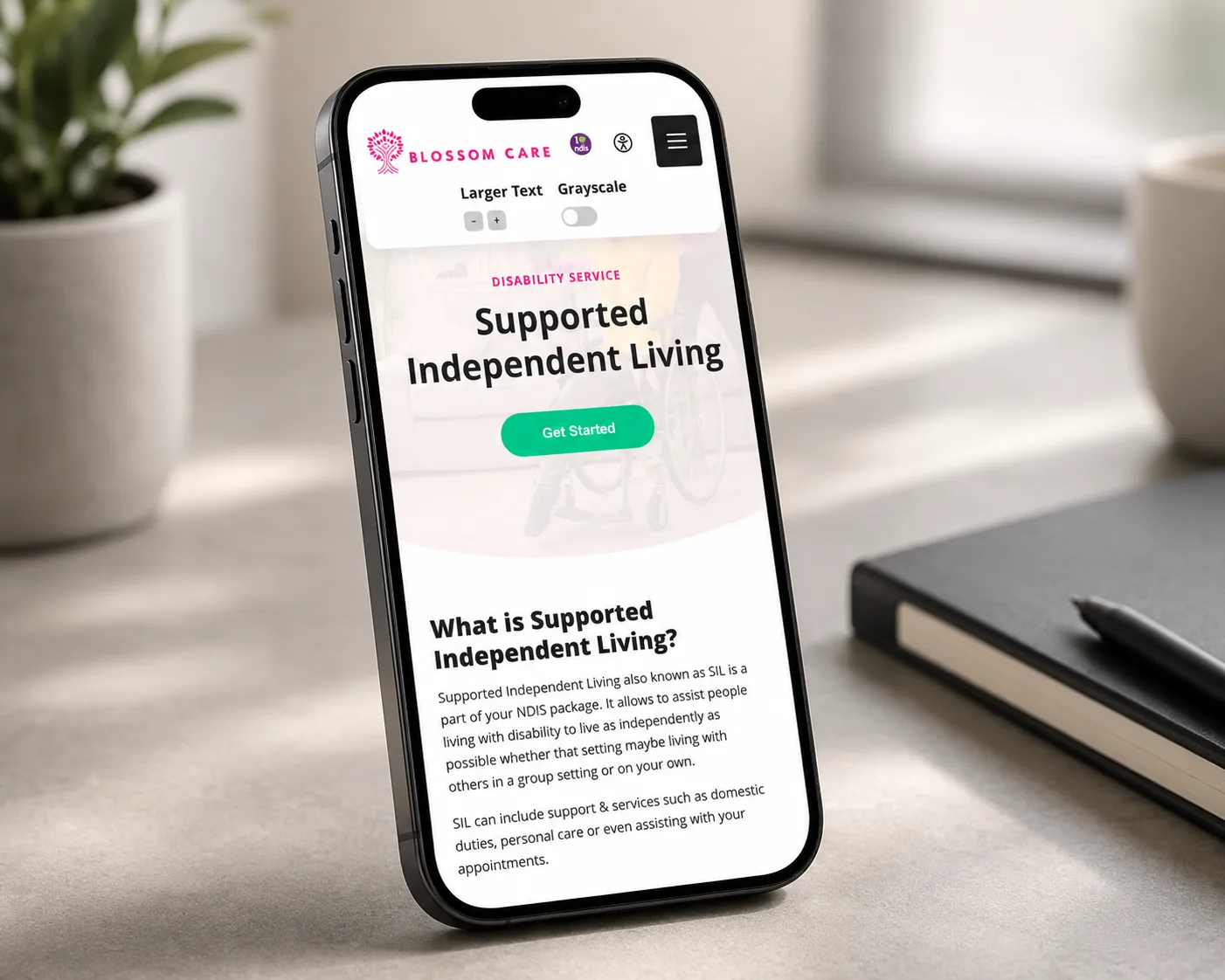
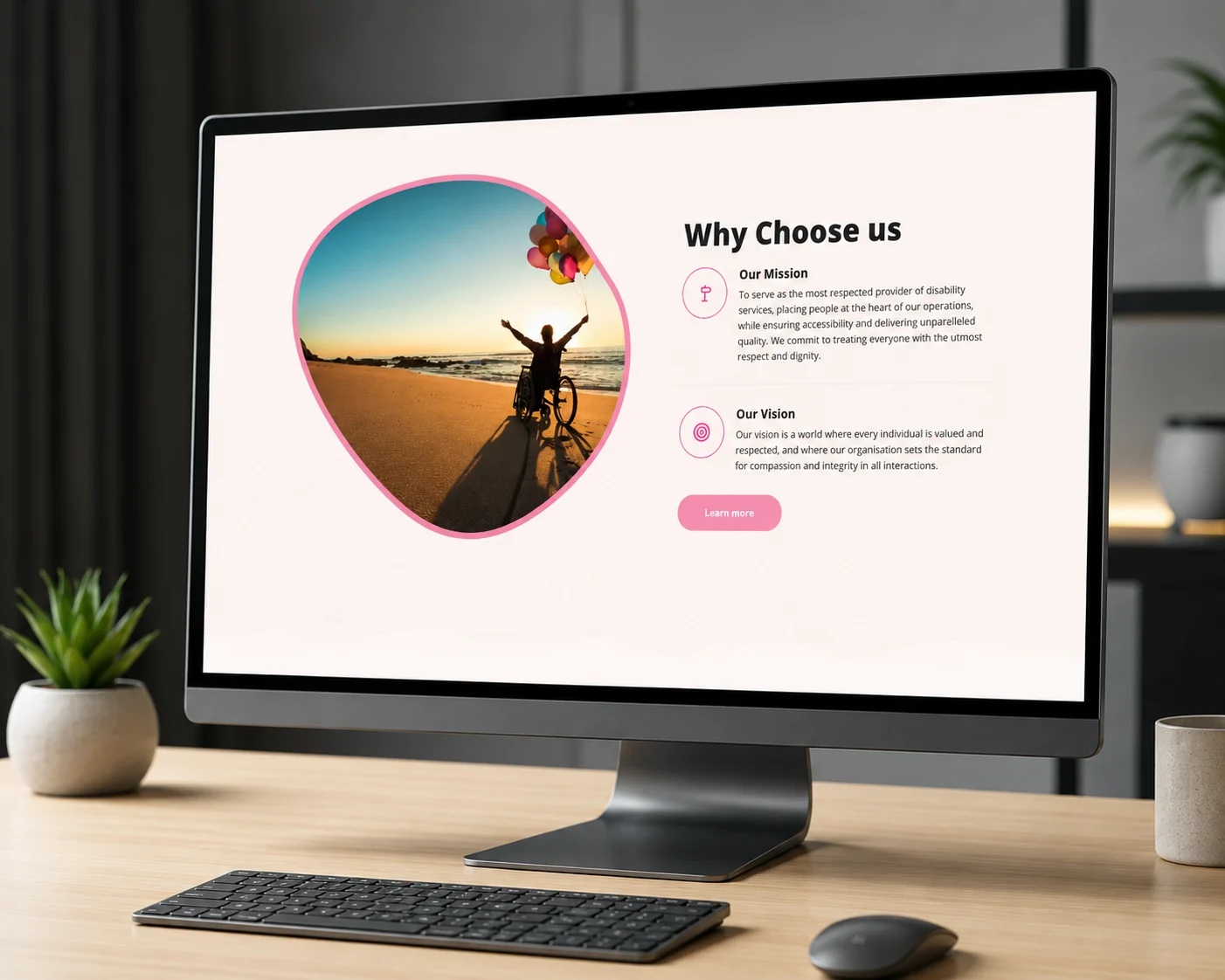
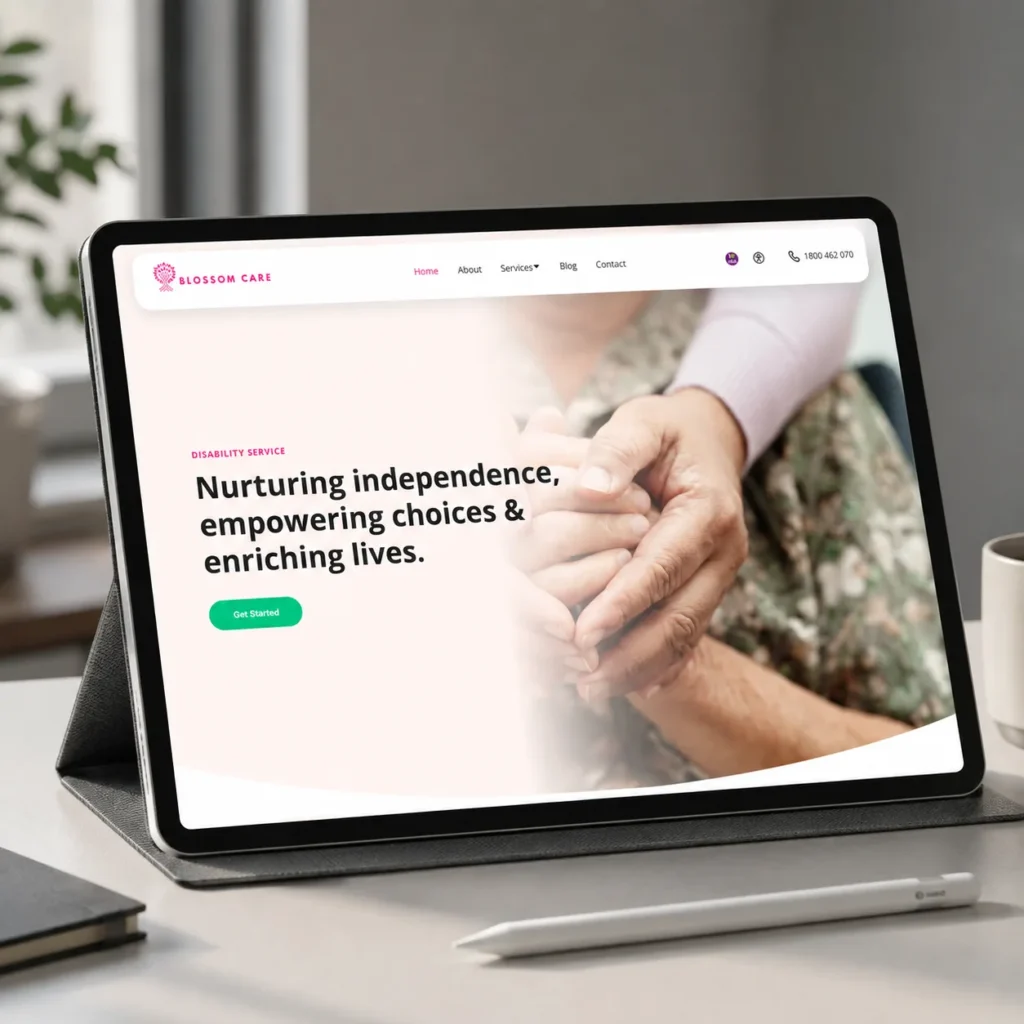
A live project
Blossom Care Disability Services
Built around your registration groups
One clear page for every NDIS service you want found
SIL
Supported Independent Living
SDA
Specialist Disability Accommodation
SC
Support Coordination
PM
Plan Management
AH
Allied Health
CP
Community & Transport
Found by the people who refer
Search visibility for NDIS providers across Australia
The SEO Launch covers keyword research page by page, service and suburb pages written for the searches your potential clients actually use, your Google Business Profile set up and filled in, structured data so search engines can read your services and your organisation, and one round of optimisation once real search data starts arriving.
01 · Search happens by service and by suburb
02 · Coordinators search differently
03 · Visibility and accessibility pull the same way
Straightforward from start to finish
A four-step process to get your NDIS website designed
01
Discovery
02
Structure
03
Build
04
Test & launch
Clear packages, all prices final, no GST added
Choose how hard the website needs to work
01 · Website build
$2,700
The accessible NDIS website, completed properly and handed to you.
- Up to 10 pages, one for every registration group
- Participant and coordinator enquiry paths, built separately
- Complaints, feedback, privacy and registration pages
- WCAG 2.2 Level AA test, written report and published statement
- Domain, hosting and files in your name
- Three rounds of changes, training session, 30 days of support
02 · Build + SEO launch
$4,000
The recommended option when the website must be credible and findable.
- Everything in Website Build
- Keyword research for each page, decided before writing starts
- A page for each service and each suburb you cover
- All page copy written for you
- Google Business Profile set up and verified
- Organization and Service structured data
- One optimisation pass once real search data arrives, about six weeks in
03 · Build + ongoing SEO
$4,000 + $790/mo
For providers treating search as a continuing referral channel.
- Everything in SEO Launch
- Monthly work on rankings, with a report on positions and enquiries
- New service pages as your registration groups grow
- Annual WCAG 2.2 Level AA re-test, report included
- No lock-in. Stop any time and keep every page
Already have a website?
Accessibility Fix · $890
A good fit
This is for you if…
- You run a registered NDIS business and your current website was built by someone who had never seen a registration record.
- You have an audit ahead and you would rather find the website problems yourself than have somebody else find them.
- You hold more than one registration group and they are all buried on one page.
- You have been told your site is accessible and you have no way to check whether that is true.
Probably not a fit
This is not for you if…
- You want a new website live this week. Our testing alone takes a day, and we would rather lose the job than skip it.
- You are not registered yet. Wait until you are, so the site can state your registration groups.
- You want the cheapest option available. A template service costs a fraction of this and is a reasonable choice for a sole trader who needs a simple website online quickly. Creating a website that way is not a reasonable choice once participants with disabilities are your clients.
Make the right-sized decision
Keep your NDIS website, build it yourself, or have us build it
Most providers are choosing between three options, and only one of them is us.
Keeping your current site costs nothing now, rarely has registration groups as separate pages, almost never has accessibility tested, rarely has a coordinator referral path, and leaves you fixing it when something breaks.
OPTION 01
Keep your current site
OPTION 02
Build it yourself
OPTION 03
Have us build it
Frequently asked questions
Frequently asked questions about NDIS website design
If your current site is the real question, start with the free check. We will tell you whether it points to a fix, a rebuild or no immediate action.
Between $2,700 and $4,000 for a new website, no GST added, depending on whether you add SEO at launch. Ongoing work is $790 a month and you can stop it at any time. If you already have a site and only need the compliance work, that is $890.
Tell us what was raised and we will fix it. If a finding lands on something we built or tested, there is no charge for the work. We cannot promise the finding will never come, but we can promise you will not be paying twice to close it.
The gap is small and it sits almost entirely on mobile: tap targets, focus that a sticky header covers, and forms that ask twice. If most of your enquiries come from phones, and for NDIS providers they usually do, the gap is exactly where your visitors are. Moving is a few hours of work, not a rebuild.
Usually not. The extra work is concentrated around mobile target sizes, focus visibility, dragging interactions and repeated information in multi-step processes. We assess the current build before recommending changes.
Local terms for a single suburb and service can move within two to three months. Broader terms take longer and depend on how many providers are already established there. Anyone quoting you a date is guessing.
No. We work with Australian providers in every state and the process runs on calls and shared documents. Nothing is sent offshore, and the person who tests your website is the person who built it.
We do, and it is included. You will spend about an hour telling us how your services actually run, and we write from that. Provider content written by someone who has not asked those questions is the reason so many NDIS websites read the same.
Probably not. Book the Accessibility Fix instead. We will test what you have, fix what can be fixed without rebuilding, and tell you honestly if a rebuild is the cheaper answer.
Nothing stops working. You keep the site and can update it yourself, which is why we build on WordPress and run the training session. If you want us to stay involved, that is the ongoing option, and it includes the annual re-test.
You do, from the first day. The domain, the hosting account and the files are registered in your name. If you leave, everything goes with you.
KEEP READING
More on NDIS websites

A useful first step
Build your NDIS website with a team that specialises in the NDIS
Tell us what is not working on your current website. We will run the keyboard test and the automated scan, then send you a short list of what we found and whether it points to a fix or a rebuild. That takes us about two days and costs nothing, and you can do what you like with the list, including take it to another agency.
If you want a new website and have nothing yet, tell us your registration groups instead and we will come back with a structure.
Prefer to talk it through?
Pick a time and we will cover accessibility, the audit and what it costs.