
Skiva Technologies is a Brisbane commercial refrigeration contractor working across Brisbane, Logan, Ipswich, Redlands, Moreton Bay, the Gold Coast and the Sunshine Coast. The customers are cafés, restaurants, bars, bakeries, butchers, supermarkets and food production sites: businesses where refrigeration is not a convenience but the thing standing between them and a day’s lost stock.
The trade credentials matter here in a way they do not in most industries, and they matter commercially rather than decoratively. Handling refrigerant in Australia requires a licence from the Australian Refrigeration Council. Skiva holds ARC licence AU066274 alongside QBCC 15418651. That is not a badge for a footer. It is the difference between a technician who can legally repair a refrigerant leak and one who cannot, and most buyers do not know that until someone explains it.
The company describes itself as having more than 15 years in the trade, trusted by dozens of businesses and 5-star rated for reliability. Those are the business’s own claims, carried over from the previous site, not measurements of this project.
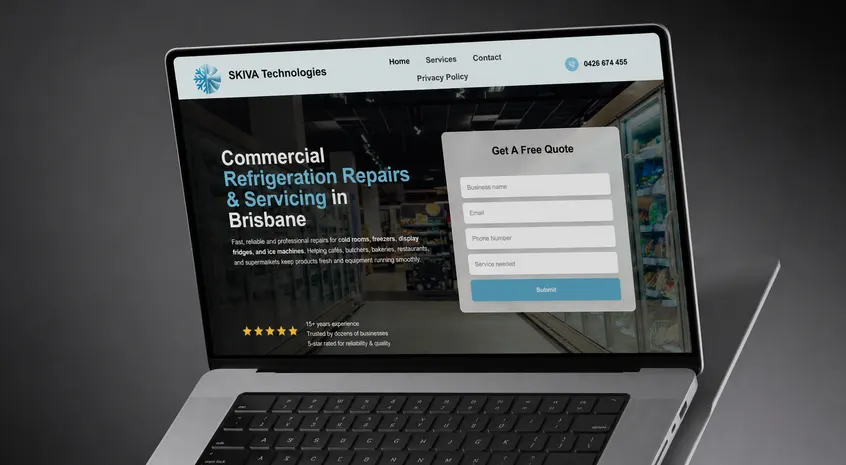
The previous site was not broken. It was too small for the business behind it.
It ran to four pages: home, services, contact, privacy. The homepage did nearly all the work, carrying the hero, a quote form, the services grid, the reasons to choose, a call to action, six questions, contact details and a second form. For a business with one offer that would be reasonable. Skiva sells eight distinct services to buyers with eight distinct problems.
The structural problem sat in the services grid. Six services were displayed as six separate tiles, and every one of those tiles linked to the same URL. A visitor who clicked Ice Machine Repairs and a visitor who clicked Cold Room Repairs landed on the same page and had to find their own service in it. The site was presenting a choice it could not actually honour.
That flowed straight into search. Someone typing ice machine repairs Brisbane has a different problem, a different urgency and a different budget from someone typing cold room repairs Brisbane or commercial refrigeration maintenance Brisbane. Those are separate intents that need separate pages, and there was exactly one page to serve all of them. One page cannot be the best answer to eight questions, so it tends not to be the best answer to any of them.
The conversion path was the last piece, and it was the most costly. Refrigeration is bought under pressure. The person searching is usually standing next to failing equipment, on a phone, with stock warming up behind them. A homepage that leads with a quote form is built for someone who is comparing options at their desk. That is not who is searching.
One honest limitation to state. The old site was not running an SEO plugin and had no meaningful measurement in place, so there is no reliable traffic, ranking or enquiry baseline to compare against. Measurement starts from this launch.
Fourteen days, four stages, each one feeding the next.
We went through the existing site for structure, mobile behaviour, and the path a visitor took before calling or submitting anything. That pass produced the finding the whole rebuild turned on: six service tiles, one destination. It also established what was worth carrying forward, which was the credentials, the service area and the client’s own trust claims.
We built the new sitemap around the eight services the business actually sells, planned a services sidebar so a visitor can move between them without returning to a menu, mapped the service areas into the structure, and decided where the emergency call and the quote request belonged before any design work started.
We set the visual direction, designed the service page template, and built reusable Elementor sections: hero, intro with services sidebar, supporting points, benefit lists, questions accordion, emergency call cards, closing action band. Every service page runs off the same components, and mobile layouts were treated as the primary case rather than an afterthought.
We wrote the service page content against a brief from the client covering equipment, faults, scope of work, brands, process and warranty, then measured the pages against each other before anything shipped. After that came forms, tap-to-call checks across desktop, tablet and phone, image optimisation, and launch.
If your site’s problem is structural rather than cosmetic, that is usually a website redesign rather than a new theme.
Giving every service its own page creates a problem worth naming, because it is the reason most businesses never do it.
Eight refrigeration service pages need the same nine blocks: equipment covered, faults fixed, scope of work, brands serviced, how the job runs, emergency callout, preventative maintenance, service area, warranty. Write those eight times and you get eight versions of one document, all chasing the same search, none of them clearly the best answer. Rewrite them eight different ways to look distinct and you now maintain eight versions of the warranty terms, five of which will be wrong within a year.
So we decided which blocks were allowed to repeat before writing anything. Process, reasons to choose, service area and warranty are identical across the pages on purpose, and they are built as reusable sections rather than copied into each page, so changing the warranty is one edit. The separation was built where two refrigeration services genuinely differ: the equipment lists, the fault lists and the scope of work.
Then we measured it rather than trusting the impression, comparing every page against every other page and every section against its counterparts.
| What was measured across the service pages | First draft | After revision |
| Average overlap across all page pairs | 26.6% | 21.9% |
| Closest pair (underbench fridges and prep cabinets) | 44.0% | 32.2% |
| Repeated passages inside a single page | 3 | 0 |
| Lines unique to one page, weakest page | 48% | 61% |
| Opening argument, shared text | 0% | 0% |
The first pass caught what reading would have missed. The two cabinet pages had quietly converged, because an underbench fridge and a prep bench are both refrigerated cabinets and their fault lists had drifted together. The three supporting points under each hero were nearly identical and repeated a section further down the same page. Those were rewritten from opposite ends of the trade: glass door fogging, door heaters and display lighting on one, pan seating and the cold air seal on the other.
One thing that table is not: it is not a search result. These are measurements of the copy, taken before launch. What the pages do in Google is a question for after they have been live long enough to answer it honestly.


The site is a custom WordPress build using Elementor, assembled from reusable sections: hero, intro with sidebar, supporting points, benefit lists, questions accordion, emergency call card, closing action band. That is what made fourteen days realistic for eight service pages, and it is what keeps them visually consistent.
The choice of WordPress came down to who maintains the site afterwards. Skiva adds services as the business grows. A ninth page should not require a developer, and with a component template it does not.
Two other options were considered and dropped. Keeping the single services page and simply making it longer was rejected first: it would have preserved the exact problem the rebuild existed to fix, and a longer page still cannot rank for eight different searches. An online booking system was also rejected for launch, because before a time can be scheduled this business needs to know the equipment, the fault and the site, and a phone call gets there faster than a booking widget.
| Element | How it is handled |
| Services | Eight dedicated pages, each on its own URL with its own heading, content, questions and call to action |
| Navigation | A services sidebar on every service page, so a visitor can move between services without returning to the menu |
| Enquiry paths | Tap-to-call emergency action, quote request, contact form, and contact details in the footer |
| Shared blocks | Process, reasons to choose, service area and warranty built as reusable sections, edited in one place |
| Local signals | Named service areas across Brisbane, Logan, Ipswich, Redlands, Moreton Bay, the Gold Coast and the Sunshine Coast |
| Trust content | ARC and QBCC licence numbers explained rather than displayed, the client’s stated 15 years in the trade, and questions answered per service |
| Quality control | A documented duplication audit with before and after figures, repeatable when the ninth page is added |
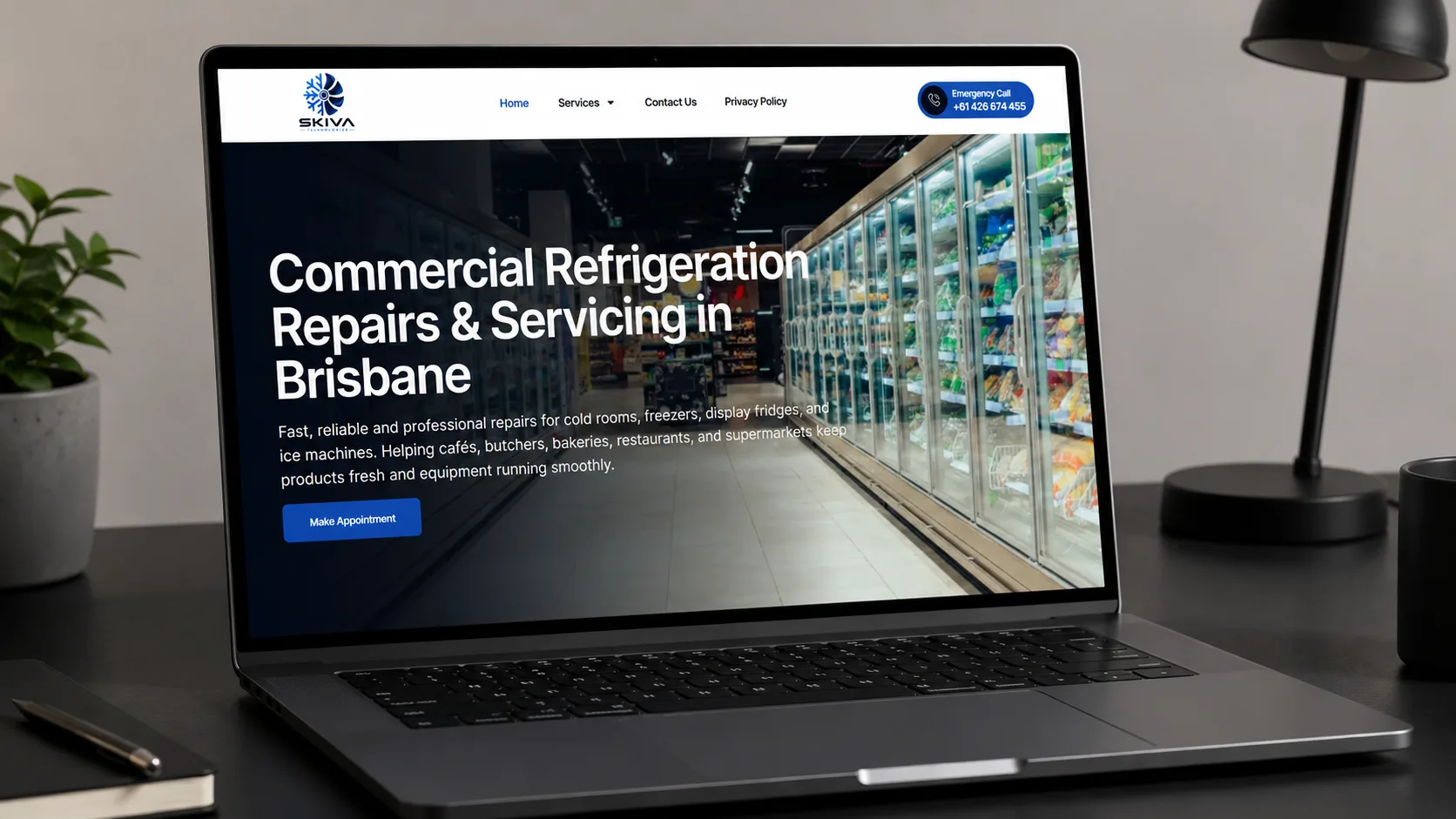
Skiva Technologies already had the licences, the trade knowledge and a clear list of what it sells. What it did not have was a website that could be found on the terms customers actually search on.
A café owner searching for ice machine repairs now lands on a page about ice machines, written by someone who knows why the cubes come out hollow, rather than on a general services page that mentions ice machines in a list. Someone standing next to a failing cool room can call in one tap instead of filling in a quote form. And because the shared blocks were built once, changing the warranty terms is a single edit rather than eight.
There is one thing the site still does not have, and it is worth saying plainly. There is no customer story on it yet. Skiva claims a 5-star rating and dozens of businesses served, but a named review from a Brisbane café or butcher would do more for enquiries than any further design work. That is the next thing worth adding.
If you sell eight services and your website presents them as one, the fix is structural rather than cosmetic. Skiva is one of three Brisbane WordPress builds we have published. Plan the right website structure with us, or see the live Skiva Technologies site and judge the work for yourself.