
BIYMC was founded in Brisbane in August 2012 by the violinist and educator Emin Tagiev, who remains its Artistic Director. It is a non-profit competition for solo instrumentalists and ensembles up to the age of 25, built around strings and piano, and it takes entrants of any nationality. Musicians can compete in person or by video submission, which is what makes a competition in Queensland reachable from another hemisphere.
The format is a real competition rather than a certificate mill. Entries run through three elimination rounds. Everyone who reaches the semi-finals receives a certificate of participation, the finalists compete for BIYMC diplomas, and the season ends with a winners’ concert at Brisbane City Hall. The judging panel is a minimum of three internationally active musicians, and an adjudicator who has a conflict of interest with an entrant, as a teacher or a parent, does not score that entrant.
Around the competition sits everything an event like this accumulates: scholarships and travel awards, an invitation-only international exchange program that has taken winners to Germany, masterclasses, and a teacher network that supplies most of the entrants in the first place.
That is a lot of moving parts for an organisation whose staff are musicians and volunteers, and it repeats every year with new dates, new fees, new categories and a new set of winners.
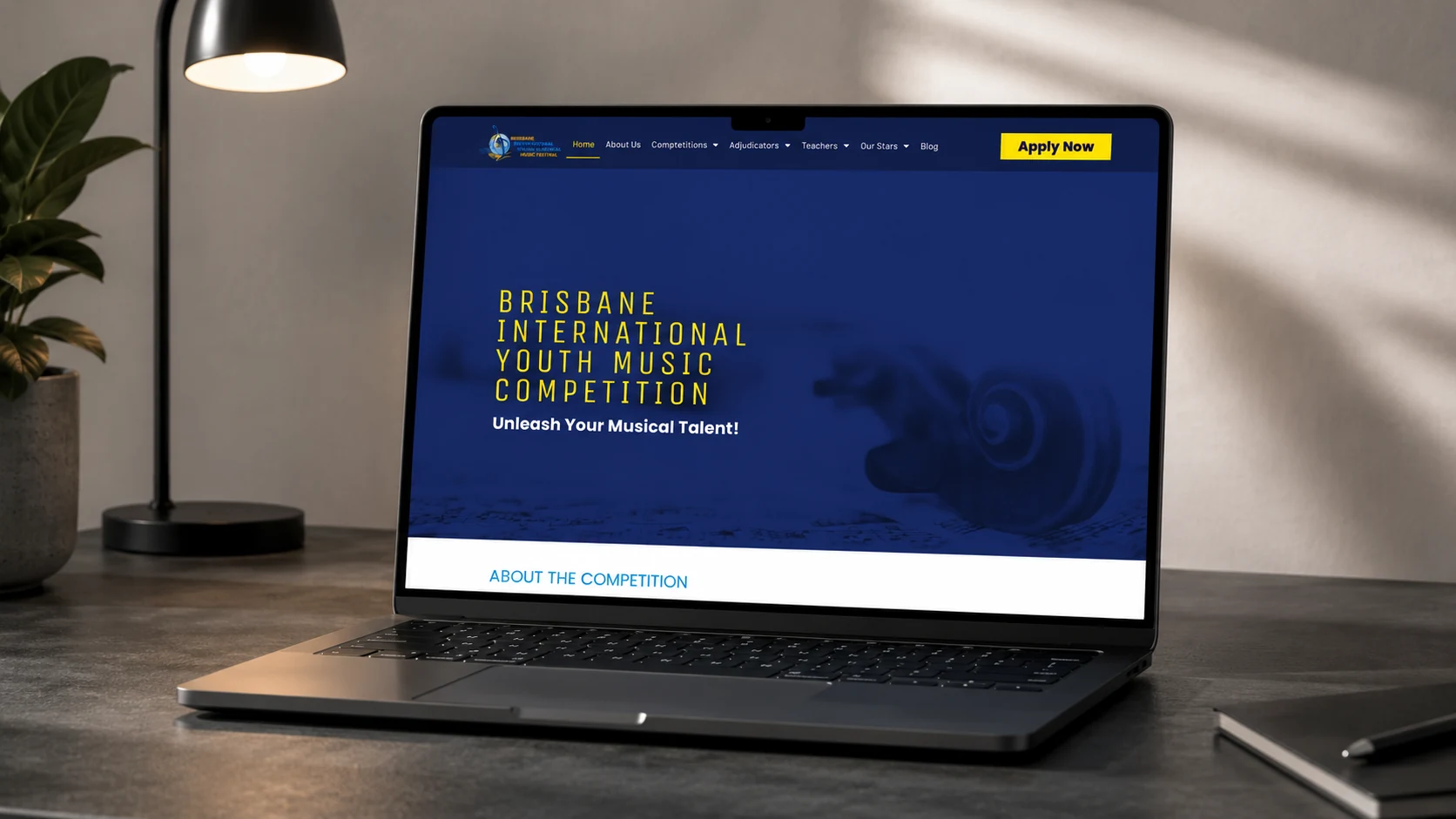
Strip away the music and a competition is an intake problem with a deadline attached.
Every entrant has to choose the right stream for their age and level, submit a form that includes their teacher, their parent or guardian, their repertoire and proof of age, attach a recording, pay an entry fee in Australian dollars from wherever they live, and do all of it before applications close. Every entry then has to reach a panel that scores it consistently, and every result has to be published in a form that a fifteen-year-old and their teacher will actually go and read.
Done by hand, this is an inbox. Entry forms arrive as email attachments, recordings arrive as links that expire, fees arrive as bank transfers that have to be matched to names by hand, scores come back as documents in a dozen formats, and the winners get typed up at the end. It works, in the way that a shoebox of receipts works, and it stops working exactly when the competition grows.
Three requirements shaped the build.
The first is that the entrant is a stranger. Most people applying have never met the organisers and are often applying from another country, in another time zone, sometimes in a second language. Everything they need to decide has to be on the page: who can enter, what to play, what it costs, when it closes.
The second is that the season changes but the machinery does not. Dates, fees, categories, judges and prizes are different every year. The forms, the payment path and the results template are the same every year. Those two things have to be separable, or every season becomes a rebuild.
The third is that the people running it are not developers. Adding a category, opening applications or publishing a new list of winners cannot require anyone to touch code.
Four steps, and the entrant does all of them in one sitting.
The site splits the competition into three: First Steps, a non-competitive festival category for beginners; Presto, for musicians under 13; and BIYMC, for 13 and over. Each has its own page explaining who it is for, what to prepare and what it costs, so the choice is made before any form is opened.
The application form collects the applicant’s details, the teacher’s details, the parent or guardian’s details, the repertoire and the recording, with a file upload for the proof of age and a link field for the video. The scholarship request is part of the same form rather than a separate process, so a family that needs it does not have to ask how to ask.
Each stream has its own entry fee as a product in WooCommerce, paid by card through the site in Australian dollars. On the day this was written the individual BIYMC and Presto fees were $189.99 and the First Steps fee was $70. Paying online means an entry arrives already reconciled, instead of a transfer that somebody has to match to a name.
Adjudicators score through a portal on the site rather than by email, and the results are published as year-by-year winners pages that stay up permanently, which is what an entrant wants to link to afterwards.
The adjudicators’ portal is the part of this build that has no equivalent on any other site we have made, and it is the part that saves the most work.
Judging by email produces a stack of documents in a dozen shapes: one adjudicator writes paragraphs, another gives numbers, a third replies in the body of the message, and someone at the end has to turn all of it into a result and a piece of feedback the entrant can read. The margin for a transcription error is enormous, and the error lands on a teenager’s competition result.
On the site, an adjudicator opens the portal and fills in one form: which performance is being scored, the assessment scores, and the written feedback. The same fields, in the same order, for every entrant and every judge. The panel’s rules live around it rather than in a covering email: a minimum of three international judges, and no scoring of any entrant an adjudicator teaches or is related to.
It is unglamorous, and it is the difference between a competition that can grow and a competition that is limited by how much its organisers can retype.


The site is WordPress with Elementor Pro on the Hello theme, extended with the Crocoblock family, JetEngine, JetElements and JetTabs, and with WooCommerce and WooPayments handling entry fees.
Each of those is there for a reason.
WooCommerce because an entry fee is a payment with a receipt, a refund policy and a record, and a payment gateway on its own gives you none of that. Making each fee a product also means fees can change per season and per stream without touching the form.
JetEngine because the winners, the categories and the repeating blocks are data, not pages. Eight years of winners typed as eight hand-built pages would be eight designs to maintain; as listings they share one template, and a new season is a new set of entries.
Elementor Pro because the organisers add and edit pages themselves between seasons. The whole point of the build is that opening applications does not require a developer.
WP Rocket, ShortPixel Adaptive Images, Rank Math and Site Kit because this is a public-facing site that competes for attention with every other youth competition in the world. Photography of performances is heavy, applications arrive from search, and the organisers need to see where entrants come from.
The alternative was a hosted competition platform, and it was rejected for two reasons that have not changed. The competition’s public face and its intake would have lived on different domains, so the moment of highest intent, a musician deciding to enter, would have handed the entrant to someone else’s branding. And the fees for a platform scale with entries, which is the wrong shape for a non-profit whose growth is exactly what it is trying to achieve.
| Element | How it is handled |
| Entry streams | Three: First Steps, non-competitive, for beginners; Presto for under 13; BIYMC for 13 and over |
| Applications | A form per stream covering applicant, teacher, parent or guardian, repertoire, recording link, proof-of-age upload and scholarship request |
| Payment | Entry fees as WooCommerce products paid by card on the site, per stream, in Australian dollars |
| Judging | An adjudicators’ portal with a single scoring and feedback form, plus a published conflict-of-interest rule |
| Results | Winners pages for eight seasons, from 2019 to 2025, kept online permanently |
| Season calendar | Published dates for applications, early bird, semi-finalists, finalists, program submission, winners and the winners’ concert, with a countdown on the front page |
| Teachers | A dedicated section with the referral program, registration, FAQ and a promo pack |
| Beyond the competition | Scholarships and travel awards, the invitation-only international exchange program, masterclasses and a blog |

BIYMC is not a project that finished. We built the current site at the end of 2024 and have run it every season since, and every season brings new dates, a new fee schedule, sometimes a new category, a new panel and a new set of winners. The winners pages from the seasons before that are the competition’s own archive, carried across rather than written by us. That arrangement is why the build was made out of repeatable parts rather than out of one-off pages.
What the site does is keep the whole competition in one place. A musician in another country can read the conditions, pick a stream, apply, attach a recording and pay in a single visit. An adjudicator scores through a form instead of a mail thread. A winner has a permanent page to link to. The organisers spend their time on the music rather than on matching bank transfers to names.
One thing we do not publish here is numbers. Entry counts, traffic and conversion belong to the client, and a case study is not the place to disclose them. What can be checked is on the site itself: the streams, the forms, the fees, the calendar and eight years of winners with their names on them.
If your competition, festival or awards program collects entries in an inbox and reconciles fees by hand, the ceiling is not your idea, it is your admin. BIYMC has run from Brisbane since 2012, one of three local builds behind our work as a WordPress web designer in Brisbane. Talk to us about the build, or look through the BIYMC site and follow an entry from the category page to the payment.