
Elvigo Fashion is a dress boutique in Monterey, New South Wales, selling evening, formal, school formal, bridesmaid and mother of the bride gowns, plus accessories. The same racks serve two businesses at once: a customer can buy a dress outright, or hire it for four days and bring it back.
That second model is the interesting one, and it is why the site is not a normal store. Hiring is a local trade. A dress that goes interstate for four days spends most of them in transit, so hire is a Sydney service with a fitting appointment attached, while buying is national. One catalogue, two businesses, two completely different customers, and until this year one storefront that treated them as the same thing.
The customer decides in front of a mirror. That makes the showroom the centre of the business and the website the thing that gets someone to book a fitting. It also means the site carries a burden most stores do not: it has to be honest about what a dress looks like on a real body, in real light, at a real price.
An audit in August scored the store 38 out of 100. The number matters less than where the points were missing, because the pattern was consistent: the site was doing the hard things and skipping the cheap ones.
The single biggest gap was structured data. Two product pages were checked and neither carried a Product or an Offer in its markup. The catalogue was in the sitemap, the feed was approved, the pages ranked, and Google was being told nothing about price, availability or condition on any of 663 indexed products. In a search result that is the difference between a listing with a price under it and a plain blue link.
Then the Search Console export arrived and made the cost of that specific. Over three months the store took 93,082 impressions and about 554 clicks a month. On positions one and two the click rate was 43.5 per cent, which is healthy and says the brand is recognised. On positions five to nine, where most of the impressions sat, it was 2.68 per cent against a normal range of five to eight. Same store, same shopper, different rung of the page. The problem was not ranking. It was that nothing in the result gave a reason to choose it.
The titles explained a lot of that. The formal dresses page said Australia while its heading, its slug and its top query all said Sydney. The robes category was described as sleepwear, which is a different purchase entirely. The flower girl category had no title at all. The plus size category was still carrying the template default. A school formal page took 826 impressions and zero clicks.
And 30 of the 40 category pages had no heading on them at all.
Four passes: look, measure, rebuild, then open the half of the business that had no door.
We went through the store from the outside first: indexation, markup, headings, speed and images. That pass produced the score of 38 out of 100 and the finding the rest of the job turned on, which was that not one product page carried the markup a shopping result is built from.
Search Console and Merchant Center replaced assumptions with numbers. That is where the click rate on positions five to nine came from, where the local share of demand came from, and where the list of disapproved products in the shopping feed came from. Every title we later rewrote was chosen from that export rather than from a keyword tool.
Product and category pages became templates rather than pages, structured data went onto every product, and the two features a dress shopper actually uses, search and the wishlist, were brought into the design of the store.
The hire catalogue was tagged so a template could select it, and the showcase was built on that tag. The page follows the catalogue instead of being a list someone has to maintain.
Product and Offer markup, with price, currency, availability, condition, SKU, brand, colour and size. Checked on the live site: a product that had none of that in August now publishes a complete offer.Half of this business is rental, and until August it had nowhere to send anyone.
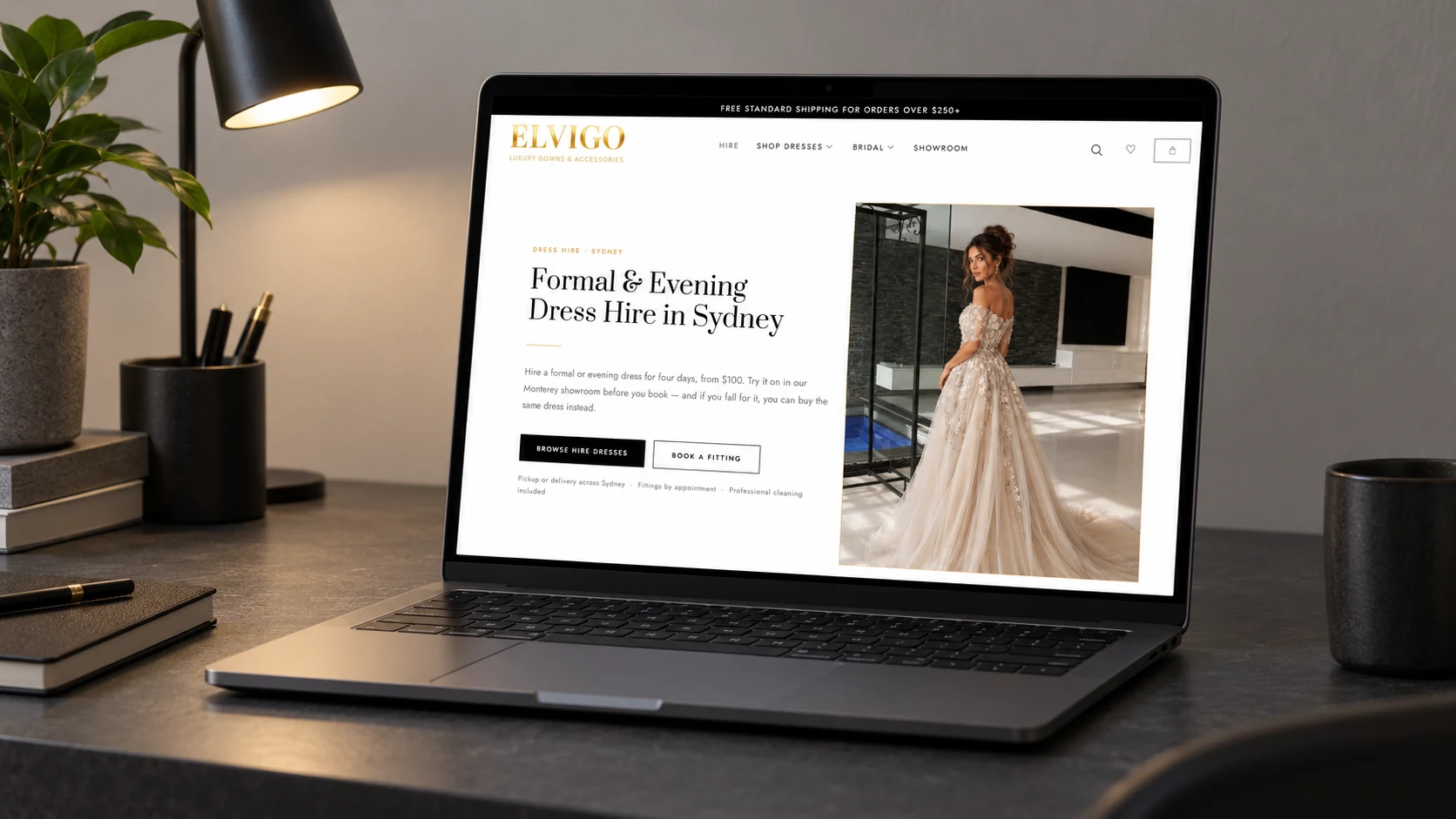
There was a page, in the sense that a URL existed: a long, old landing page ranking at position 71. There was a catalogue, in the sense that 247 dresses had a hire counterpart recorded in the database. What there was not was a page a customer could land on, understand and act from, and no way for a template to gather those 247 dresses in one place, because nothing in the data marked them as hireable.
We tagged them, and built the showcase on the tag: twelve sections covering how hiring works start to finish, what is included, the fitting, sizes, delivery, and the choice between hiring and buying. The grid is a live query, so the page follows the catalogue instead of being a list somebody has to remember to update.
Three of the strongest decisions in that page came from the owner and made it more honest rather than less. Hire is Sydney only, because four days is not enough for a dress to travel interstate and back, so interstate customers are offered the purchase instead. Fittings are by appointment, so no wording invites a walk-in. And the size range is stated as an Australian 6 to 20 rather than 2 to 20, because the smaller sizes in the catalogue are children’s flower girl dresses and quoting them would have made the range look wider than it is.
The page is also deliberately quiet about how many dresses are available to hire. The catalogue changes weekly, and a number in the copy is a number that goes stale.
We were equally direct about the demand. Over three months, searches containing hire or rent brought the site 55 impressions in total. The two national rental brands in this market pull tens of thousands of visits a month and have the link profiles to match. The hire page was built because the business is real and the customers who reach it are worth serving, not because a keyword volume said so.
One number in the Search Console export reframed the whole job: a quarter of the store’s impressions came from searches with a place in them. 332 queries, 23,434 impressions, and a click rate of 1.22 per cent.
That is a shop with a showroom being found by people looking for a shop with a showroom, and mostly not being chosen. The Google Business Profile was healthy on its own terms, with 7,637 impressions a month and a five star average, and the address, phone and name on the site matched the profile exactly, which is the part that usually goes wrong and here did not.
What the profile did not say was what the business does. It carried two categories, dress shop and formal wear shop. Nothing about hire. Nothing about bridal. Accessories, which produce the third and fourth most visited pages on the whole site, were not represented anywhere in the profile. A customer searching for dress hire near them was being matched on the strength of two categories that do not mention it.
That finding went to the owner rather than into a change, because a business profile is the owner’s asset and its categories carry consequences for how the business is shown for years.


Every change on this store went in as a named, dated snippet with the previous values saved first.
That sounds like bookkeeping and is actually the whole risk model. This is a live shop taking orders. A theme edit on a store like this is a change nobody can find later, made in a file the next theme update overwrites. A snippet has a name, a number and an off switch, and the values it replaced sit in a backup file next to it, so any single change can be reversed on its own without touching the others.
It earned itself back in August, when a WordPress core update landed overnight and broke part of the site. Because every one of our changes was isolated and reversible, working out what the update had broken did not mean working out what we had broken.
| Element | How it is handled |
| Product markup | Product and Offer on product pages, with price, availability, condition, SKU, brand, colour and size |
| Product page | A single template, with working gallery thumbnails and a hire enquiry modal |
| Category page | A single template, with heading, introduction and FAQ on every collection |
| Collection titles | Rewritten on 21 of about 27, each from its own Search Console data |
| Hire | A twelve section showcase, built on a live query over 247 tagged dresses |
| Hire logistics | Sydney only, pickup or delivery, fittings by appointment, sizes 6 to 20 |
| Product images | Titles and alt text on 284 products with a SKU |
| Shopping feed | 73 rejections traced to 55 missing prices and 14 missing images, listed for the owner |
| Rollback | Every change made through a named, dated snippet with a saved copy of the previous values |

Elvigo Fashion was never short of product or short of rankings. It was short of the small signals that turn a listing into a visit, and short of a place to put half of its business.
A shopper who searches for a formal dress in Sydney now sees a result that says Sydney, at a price, in stock. A shopper who wants to hire has a page that explains the four days, the fitting, the cleaning and the cost, instead of a category listing that never mentioned hire at all. And when the catalogue changes, the hire page changes with it.
The parts we could not finish are as clear as the parts we could. Six collections still carry their old titles. Fifty five products cannot enter Shopping until somebody decides what they cost. Rankings on several pages will not move on titles alone, and we said so rather than promising otherwise.
If your products sit on the first page and the clicks do not follow, the fix is usually in the result rather than the ranking. Talk through your website needs with us, or see the Elvigo Fashion store and judge the work for yourself.