In brief
- A .com.au domain name registration is a licence for a term of 1 to 5 years, not ownership. The rules say so in one line.
- You need an Australian Presence and, for .com.au, a commercial entity behind it: usually an ABN or an ACN.
- The domain name has to match your business name, your trade mark, or what you actually sell.
- The first year tells you nothing. Renewals ran from $19.95 to $31.95 a year when we checked 6 registrars on 17 November 2026.
- Your own WHOIS record is public. It takes 2 minutes to find out whether the licence stands in your name or your old web developer’s.
This is general information about published rules, not legal advice. Every rule quoted here comes from the version of the auDA Licensing Rules that commenced on 12 April 2021. auDA has an open consultation on changes, so check the current text before you rely on it.
What you actually buy when you register a com.au domain name
Australian domain name registration looks like a purchase, and the paperwork encourages that reading. You pay a registrar, the domain name appears in your account, and the invoice says domain registration.
It is not a purchase. The auDA Licensing Rules put it in a single line: ‘A licence confers No Proprietary Rights In a Domain Name’. What you hold is a .au domain name licence issued by .au Domain Administration. The term is a ‘period of 1, 2, 3, 4 or 5 years’, renewable, and the name goes to whoever applies first. Where 2 complete applications compete, the registry’s receipt time is the only tiebreaker.
The industry is inconsistent about this. Webcentral’s domains page says that once you register, ‘you have full ownership! Others can’t register it until you release it’. Further down the same page it calls the same purchase a lease: ‘When you buy a domain name, you’re effectively leasing the name for a specified period’. GoDaddy’s Australian guide is careful about trade marks, then adds that registration ‘only means you own that specific website address’. Both pages were read on 17 November 2026.
The difference shows up in 5 practical places, and the rest of this article is those 5. Who may hold the licence. Which names are allowed. What it costs to keep. Whose name the registry has on it. What breaks it mid-term.
Who is allowed to register a com.au domain name
Yes, you generally need an ABN. That is the short answer to the question people actually search.
An ABN is one route of several. Every applicant ‘must have an Australian Presence’, defined as any of these:
- an Australian citizen or permanent resident visa holder
- a company registered under the Corporations Act 2001
- a registrable body with an ARBN
- an incorporated association or similar organisation under state or territory law
- ‘an entity issued with an Australian Business Number’
- an Indigenous corporation
For .com.au and .net.au there is a second test: the applicant ‘must be a Commercial Entity’. That definition lands in much the same place. A company, a Commonwealth entity, a registrable body, an incorporated association, or ‘an entity or natural Person issued with an Australian Business Number’.
So a sole trader with an ABN qualifies. A company with an ACN qualifies. A foreign business with an Australian trade mark can qualify. The catch is in the matching rule: the name then has to be an exact match to the trade mark.
The route you use at checkout does not disappear afterwards. It becomes the Eligibility Type in your public registry record, the field this article spends most of its time on. The same ABN belongs in your website footer, where customers and suppliers look for it.
What the domain name itself has to be
Most advice about choosing a domain name is branding advice: short, memorable, easy to spell. Useful, and beside the point if the domain name you want is not allowed.
Allowed names are narrower than that. The rules permit a name that is a Match, an Acronym or a Synonym of one of these:
- the holder’s company, business, statutory or personal name
- the holder’s Australian trade mark
- a partnership or a trust the holder is part of
- the goods, services, events, activities or premises the holder actually provides
This allocation test is assessed at the time of the application, not for the whole term.
Match has a precise definition. The name must be ‘identical to one, some or all of words or numbers used in the Person’s Legal Name, Business Name or Australian Trade Mark’, in the same order, with nothing added. 5 things are ignored in the comparison: commercial status identifiers such as ‘Pty Ltd’; DNS identifiers such as com.au; punctuation marks; articles such as ‘a’, ‘the’, ‘and’ or ‘of’; and ampersands.
Their own worked example settles it:
A person with a business name ‘Forexample Publishing’ would be able to register forexample, forexamplepublishing, forexample-publishing, and publishing as domain names.
The Synonym route is the one that surprises people. A word that ‘means exactly or nearly the same thing as another word in the English language’, judged against the Oxford Australian Dictionary or Thesaurus, can stand in for the name of a service you provide. A plumber can hold a name built from plumbing words. A florist cannot hold a name built from accounting words.
One prohibition sits beside all of this. Registering a name with ‘the sole purpose of selling, leasing or holding’ it for revenue is domain name monetisation, and the rules list warehousing and domain parking as examples. Buying names to resell is not what the .au namespace is licensed for.
How domain name registration works, the short version
The mechanics take one sentence. Pick a name, check it is free, choose an accredited registrar, give the entity details and the eligibility number, pick a term, pay. Every guide to this walks those same 6 steps, including the official one at business.gov.au, so we will leave it there. The steps are not where businesses get hurt.
The decisions are, and only one of the 4 is hard to change later:
- The domain name. Changing it later means a new licence and a redirect, and every printed card is wrong.
- The namespace. .com.au, the shorter .au, or both, which turns on the eligibility test rather than on taste.
- The term. Anything from 1 to 5 years, your choice, priced per year.
- The entity the licence is issued to. This is the hard one. Fixing it later is a transfer, and a transfer can be refused if the new holder is not eligible.
The fee has 2 parts, which is why quotes differ so much. The rules define the Licence Fee as ‘a fee paid by the Registrant which incorporates two components’. One is ‘a wholesale amount charged by the Registry Operator’, the other ‘a retail amount charged by the Registrar’. 2 parties also keep records of your licence: your domain registrar, and the registry. The registry’s copy is public, and reading it is the best 2 minutes you will spend on this.
What a .com.au domain costs over 5 years, not over the first year
Price appears on plenty of the pages ranking for this search, because most of them sell domain names. What none of them does is date the figure or work out what holding the name costs over 5 years. Here is ours, read from the published pages on 17 November 2026.
What 6 registrars published on 17 November 2026
| Registrar | First year | Then | Minimum term |
|---|---|---|---|
| GoDaddy AU | $0.05 | $21.95 / yr | price requires a 3 year purchase |
| VentraIP | $2.00 | $24.95 / yr | 1 year |
| Zuver | $2.00 | $24.95 / yr | 1 year |
| Webcentral | $15.95 | $31.95 / yr | 1 year |
| Digital Pacific | $39.90 / 2 yrs | same | 2 years, so $19.95 a year derived |
| Crucial | $39.90 / 2 yrs | same | 2 years, so $19.95 a year derived |
Over 5 years, on those prices
- GoDaddy AU: $87.85
- VentraIP and Zuver: $101.80
- Webcentral: $143.75
- Digital Pacific and Crucial: $119.70, and only as 6 years, because the term is sold in 2 year blocks. That works out at $19.95 a year
The spread is $55.90 for the identical licence. Nothing about the domain name is different. The registry charges every registrar the same wholesale price, so that is not the reason either. auDA publishes it: ‘Wholesale price per annum set as of 1 October 2026: AUD$9.50 for a domain name licence in any .au namespace’, exclusive of GST. That was a rise from AUD$8.64, announced on 6 August 2026 with a quality programme that rebates registrars ‘up to AUD$0.45 per .au domain name licence per year’.
A $24.95 renewal is therefore more than double the wholesale cost of the licence. The retail prices above are quoted as each page shows them, and not every page states whether GST is included. Treat the multiple as a rough shape rather than a precise ratio. That shape is the market, not a scandal: the margin pays for the account, the support, and the 2 cent first year someone else got.
Another 4 registrars were on our list and blocked automated access: Crazy Domains, Netregistry, Namecheap and one wholesale-only provider. We left them out rather than estimate their prices. Prices also move, so treat the table as a dated snapshot, not a league table. If you want the cost of the whole site rather than the name, we published what a website costs in Australia separately.
Which Australian domain name extension to choose: com.au, the shorter .au, or both
These 2 namespaces have different front doors. A .au direct applicant ‘must have an Australian Presence’, and that is the whole test. A .com.au applicant has to pass that test and be a commercial entity as well. A plain .com sits outside the .au rules altogether, with no Australian test and no auDA licence.
The domain extension decides more than it looks. An individual without an ABN can hold a .au domain name and cannot hold the .com.au equivalent. A business that trades under a personal name can hold both. The priority allocation process that governed the launch of .au direct is finished, so today it is first come, first served like everything else.
Holding both of these domain name extensions costs a second renewal every year, for one benefit: nobody else runs a near-identical address. If your name is distinctive and your market is local, one name is usually enough. If your brand is short, generic or already typed wrongly by customers, pay for the pair and redirect one.
Whose name is on the licence, and how to check the WHOIS record in 2 minutes
One page in the 20 we read even raises this question, and it answers in 2 paragraphs. Here is the long version, and the reason this article exists.
The registry publishes the holder of every .au name. Contact details are redacted. The facts that decide an argument are not: who holds the licence, what number proved eligibility, which eligibility type was used. Your registrar holds the account, the billing and the contact record; the registry holds and publishes the licence record. The lookup is the registry’s own WHOIS service at whois.auda.org.au. Put your domain name in, pass the captcha, and read these fields.
Ours, read on 17 November 2026, says:
| Field | Our record | What it means for you |
|---|---|---|
| Registrant | ALDUKHOV, VASILII | The licence holder. This should be your business or your own name, not your developer’s |
| Registrant ID | ABN 78494398487 | The number that proved eligibility. Check it is yours |
| Eligibility Type | Sole Trader | The route used at application: Company, Sole Trader, Partnership, Trust, Registered Business |
| Registrar Name | Cheaper Domains Pty Ltd | Who you renew with, and who can move the licence |
| Status | serverRenewProhibited, reason ‘Not Currently Eligible For Renewal’ | Common: 11 of the 12 .au records we pulled carried this flag. It says the name cannot be renewed at this moment. Ask your registrar what it means on your record rather than guessing |
| Name Server | ns1 and ns2 at our host | Where the domain name points, usually at your web hosting. Not the same thing as who holds it |
If the Registrant field names a web developer, an agency or a staff member who left, you do not own the address your customers type. Ask for the transfer in writing first, with the registrar named and the authorisation code requested. A WordPress build where the licence stays in the business name is the normal arrangement. Most providers will move it without argument, because holding a client’s name is a liability for them too.
Where the answer is no, auDA runs a complaints and disputes process for .au names, and a lawyer is the next step after that. 2 things to know before you start. A transfer can be refused if the proposed holder is not eligible, so sort the ABN or ACN first. The registry’s record is the evidence, so take a copy of it today.
Eligibility does not stop on the day you register
auDA is blunt about this: ‘You must remain eligible for your name for the entire licence period’. The consequence is on the same page: ‘If you are not eligible at any point during your licence period, you risk losing your .au domain name.’
Worth separating the 2 tests. The matching test on the name itself is assessed when you apply, so changing what you sell later does not void the name. The eligibility test is different: the Australian Presence and the commercial entity behind the licence have to hold for the whole term. Lose the entity and you lose the licence.
The mechanism is spelled out in their words. ‘A Registrant must continue to be a Person to hold a Licence.’ If that stops being true, the licence is ‘deemed to be cancelled by the .au Domain Administration, 30 calendar days from the date the Person ceases to exist’. The only way out is evidence that a transfer was agreed before then. Their own example is a company that gets deregistered.
So the events that quietly break a licence are ordinary business events:
- A company restructure where the old entity is wound up and the name stays with it.
- A deregistration, voluntary or not.
- A cancelled ABN after a business stops trading and restarts under a new number.
The renewal windows are worth a diary entry. You can renew your domain from 90 calendar days before expiry. Miss the date and you have 30 calendar days after it to apply. After that, auDA’s own warning applies: services using the name ‘will stop working and the domain name may become available to be registered by someone else’.
In our sample of 600 Australian business names, 13 no longer resolved at all 2 months after we collected them. That does not prove a lapsed licence, and we have not checked why each one went dark. It does show how quickly a live address becomes a dead one.
Who controls the DNS and the mail after the domain is registered
Holding the licence is one thing. Controlling where the domain name points is another, and most small businesses have never checked the second.
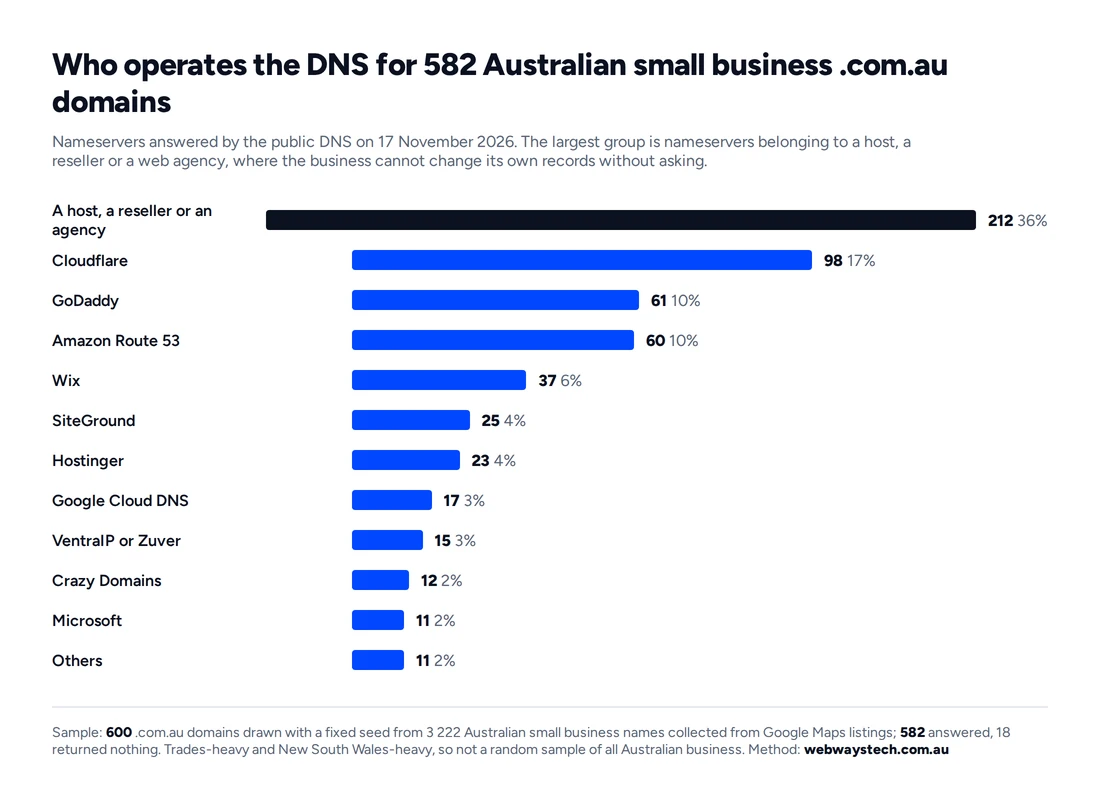
We measured it. On 17 November 2026 we queried 600 Australian small business .com.au domains. They were drawn with a fixed seed from 3 222 names collected from Google Maps listings for our own outreach. The sample leans heavily to trades and to New South Wales. Read it as a picture of service businesses, not of Australian business as a whole. Of the 600, 582 answered.
| Who operates the zone | Domains | Share |
|---|---|---|
| A host, a reseller or a web agency | 212 | 36% |
| Cloudflare | 98 | 17% |
| GoDaddy | 61 | 10% |
| Amazon Route 53 | 60 | 10% |
| Wix | 37 | 6% |
| SiteGround | 25 | 4% |
| Hostinger | 23 | 4% |
| Everyone else, including Google and Microsoft | 66 | 11% |
Shares are rounded, so the column adds to 98%. The largest group is the one with no brand on it. Those 212 names answer from nameservers belonging to a host, a reseller or, in a handful of cases, a web agency by name. That is not wrong in itself. It is how most small sites are set up. It does mean the business cannot change where its own name points without asking someone.
Mail, and the 16% with none of it
Mail tells the same story from another angle. Microsoft 365 carries the mail for 166 of the 582 and Google Workspace for 106. A host or their own server carries it for 211, and 6 use someone else. And 93 of them, 16%, publish no mail record at all. Those businesses write from a free mailbox while owning a perfectly good address.
DNSSEC is worth a line, without a recommendation attached: 6 zones out of 582 are signed. That is 1%.
The piece of control you can take today is smaller and more useful than any of this. Every .au domain name licence has an authorisation code, the string that moves it between registrars. You may accept the registrar’s code or choose your own, and change it at any time by telling the registrar. The rules also oblige you to ‘take all reasonable measures to secure the authorisation code’. If you do not know yours, you cannot move your domain name in a hurry.
Questions we get asked
Do you need an ABN for a .com.au domain?
Usually, yes. An ACN works, and so does an Australian trade mark that exactly matches the name. What the rules require is an Australian Presence plus a commercial entity, and an ABN is the most common proof of both.
How much does a .com.au domain cost in Australia?
Domain registration in the first year ran from $0.05 to $15.95 at the 6 registrars we checked on 17 November 2026. Renewals ran from $19.95 to $31.95 a year. Over 5 years the same name came to between $87.85 and $143.75. One registrar sells only 2 year blocks, so there it is $119.70 for 6 years.
How long does registering a domain name last?
A .au domain name licence runs for 1, 2, 3, 4 or 5 years, whichever you choose and pay for. You can renew from 90 days before expiry and for 30 days after it.
How do I find out who my domain name is registered to?
Look the domain name up in the registry’s WHOIS and read the Registrant, Registrant ID and Eligibility Type fields. The holder is public, the contact details are not.
Can someone else register my business name as a domain name?
Yes, if the name is free and they are eligible to hold it. Registering a domain name is first come, first served, and it is not a trade mark. Holding the name is how you keep it.
How do I move a domain name out of my web developer’s name?
The holder of the licence starts it, not you, so the first step is a written request to whoever is named as Registrant. The transfer needs the authorisation code and a holder who passes the eligibility test. Where the answer is no, auDA runs a complaints and disputes process for .au names.
Check your own record today
Spend the 2 minutes. Look up every domain name your business uses and read the Registrant field. Does the licence sit in your business name, with your ABN, and do you know who renews it? If so, you are ahead of most of the 600 sites we measured.
If not, that is a fixable problem, and it is much easier to fix while the current arrangement is friendly.
Want someone to build the site and hand over the keys at the end? That is how we work. The licence stays in your name, and the logins come with it.