Every AI-for-tradies article is written by someone selling an AI tool. That’s not an accusation, it’s just how the category works: the AI coaching program, the AI phone agent, the job management app with a new AI tab all have a reason to tell a business owner this is the year automation changes everything. We don’t sell any of it. We build websites for trade businesses, so the honest answer either way costs us nothing.
Here’s what’s actually shipping in 2026, sorted by whether it saves a real hour or just sounds like it should.
Key takeaways
- ServiceM8 and Tradify have both shipped AI features inside the software many tradies already pay for. Check what you already have before buying a separate app.
- Voice-note-to-quote tools draft fast. They don’t set your price. The judgement is still yours.
- AI phone answering for missed calls runs roughly $99 to $700 a month across Australian vendors, and nobody publishes independent testing of how well any of them actually handle a call.
- An AI chat widget on your own website and an AI phone agent are two different products solving two different problems, and most articles on this topic blur them together.
- The weakest AI claims are the ones about judgement: pricing a job, deciding what a photo of damage actually means, writing ad copy that sounds like you.
What’s already inside the software you pay for
Before buying a new app, check the one you’re already paying for. Two of the biggest trade job-management platforms in Australia shipped AI features directly into their existing plans in 2026.
ServiceM8 added Auto-Quote and Auto-Invoice, which draft a quote or invoice from the job card: the description, checklist, time tracked and any supplier correspondence already on file. There’s also an AI writer for job descriptions and a voice-activated assistant called ServiceM8 Chat that can action tasks from a spoken instruction. According to ServiceM8’s own figures, small businesses use the writing assistant more than 1,200 times a month on average.
Tradify’s SmartTools work differently. SmartRead points your phone at a paper supplier bill and pulls the cost lines into the job automatically, which matters most for a business running a trade account with regular counter pickups. SmartWrite drafts and tidies job descriptions and can shift a customer message between friendly and formal. Both sit on Tradify’s Plus tier, at $61 a user, not the base plan.
The pattern across both: none of this is a new subscription to evaluate from scratch. It’s a feature toggle inside software already running your jobs, which is the cheapest way to find out whether AI-assisted admin is worth anything to your business.
Voice note in, quote draft out
A second category of tool takes a voice note or a photo and turns it into a draft quote. Stand at the job, describe what you’re seeing, and a line-itemed draft appears before you’re back in the van.
What it’s genuinely good at: getting words on a page faster than typing on a tailgate. What it doesn’t do: set your price. The line items still need your judgement about margin, site access, and what always goes wrong on a job like this one. A fast draft is not the same thing as an accurate quote, and treating it as one is how a job gets under-priced by someone who was pleased with how quickly the paperwork came together.
Missed calls and the AI receptionist
This is the category with the most money behind it, and the least independent evidence.
The pitch is straightforward: a tradie on a roof cannot answer the phone, the call goes to voicemail, and the caller rings the next name down the list. An AI phone agent answers instead, captures the job details, and books it into the calendar. Australian vendors in this space price it anywhere from about $99 to $700 a month, usually with a setup fee on top, and the range is wide because trade-specific branding costs more than a generic answering script.
What’s missing from every vendor’s page, including the honest ones, is any independent test of call-handling quality. Nobody publishes what happens when a caller has an accent the model struggles with, describes a problem in three run-on sentences, or asks something outside the script. One job-management vendor comparing prices in this category says as much themselves, noting their own price table is “a price comparison, not a quality ranking.” Budget for a trial period before a yearly contract, and listen to your own test calls rather than a demo reel.
On your site, or in a separate app: a distinction most guides skip
Nearly every AI-for-tradies article lumps “AI on your website” and “AI answering your phone” into the same bucket. They’re not the same product, and the difference matters if you’re deciding where to spend first.
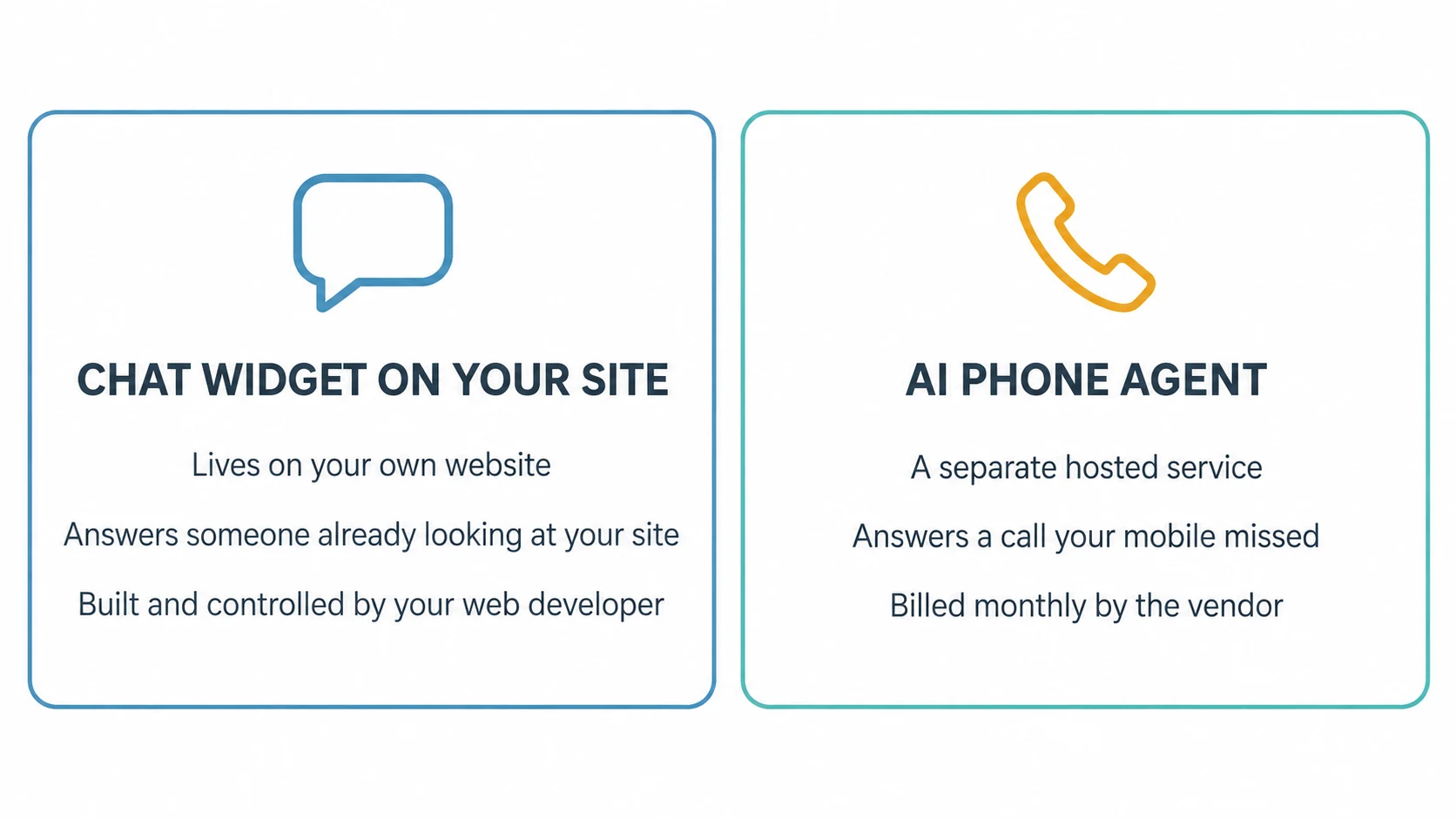
An AI chat widget embedded on your own website answers questions from someone already looking at your site: what you charge for a call-out, whether you cover their suburb, what to do about a burst pipe right now. It lives on infrastructure you control, and a web developer can wire it into your existing enquiry form and CRM.
An AI phone agent is a separate service that intercepts calls before they reach your mobile, usually hosted by the vendor, billed monthly, and unrelated to whatever your website does. Buying one doesn’t upgrade the other. If your site currently sends every enquiry through a plain contact form, a chat widget closes that gap directly. If your problem is specifically the phone ringing out on site, a phone agent solves a problem your website never touched in the first place. Confusing the two means paying for the wrong fix.
What’s still hype
Two claims are worth treating with real scepticism in 2026.
The first is AI setting your price. Drafting a quote is not the same as pricing one, and no tool on the market claims otherwise once you read past the headline. The second is AI writing that sounds like you rather than like AI. Every SmartWrite-style tool can tidy a sentence; none of them know that you always mention the drop sheets or that you never quote a job without seeing the switchboard first. That knowledge is still yours to write down, not the model’s to infer.
Where to start this week
Don’t sign up for anything yet. Open the job management software you already pay for and check its own settings for an AI tab, since ServiceM8 and Tradify customers may already have access to a feature they haven’t turned on. If there genuinely isn’t one, pick a single admin task that eats real hours, most often quoting or missed calls, and trial one tool against it for thirty days before deciding it’s worth a monthly fee. Test the actual failure case, not the demo: an accent, a mumbled address, a job that doesn’t fit the template.
Frequently asked questions
Will AI replace tradies?
No tool on the market drafts a quote without your pricing judgement, diagnoses a fault from a description alone, or shows up to do the work. AI is drafting the paperwork around the job, not doing the job.
Do I need to be technical to use any of this?
The tools built for trades assume you’re not. Voice-note quoting and photo-based bill capture exist specifically because typing on a job site is the actual barrier, not the concept of AI.
What should I try first?
Whatever is already inside your job management software, since it costs nothing extra to switch on and test.
Is an AI phone agent worth it if I already have a chat widget on my site?
They solve different problems. A widget helps someone already on your site. A phone agent catches a call your mobile missed. Neither replaces the other.
Where to start
Check the AI tab in the job management software you already pay for before adding anything new. If your site’s only enquiry path is still a plain contact form, that’s the gap worth closing first. Our website design for tradies service builds that in from the start, and you’re welcome to tell us what you’re dealing with.
About the author. Vasilii Aldukhov is the founder and developer at Web Ways Tech, a Sydney web design studio building WordPress websites for Australian trade businesses. Read more on the about page.
This article describes AI features and pricing as published by the vendors named, checked in September 2026. Vendor-reported statistics, such as usage figures published by software companies about their own products, are presented as vendor claims rather than independently verified results. Prices and features change; check current vendor pages before buying anything.