Starting an online store in Australia has an order to it, and the order is not
negotiable. You cannot register a .com.au domain without an ABN. You cannot register
for GST without an ABN either. You cannot set your prices sensibly until you know
which side of the GST threshold you sit on, and you cannot write your returns page
by copying the one that came with your theme.
Most guides give you ten steps. Ten steps suggest you can shuffle them. This one
covers what has to be true before you can take a first order, in the sequence the
dependencies actually run, and what the store itself has to show a buyer once it
is live. At the end there is a measurement of thirty Australian stores, because
what everyone else publishes turns out to be a useful guide to what to avoid.
Key takeaways
- An ABN comes first. It is free and usually issued on the spot, and without it you
cannot get a .com.au domain or register for GST. - The GST threshold is $75,000 in turnover. Below it, registration is optional.
Above it, you have 21 days. - Australian Consumer Law decides what your returns page may say. The ACCC has already
swept more than 2,000 retail websites
and written to businesses about it. - From 1 October 2026, you cannot add a surcharge for Visa, Mastercard or eftpos.
Price accordingly. - Of thirty Australian stores we measured, one told buyers that prices include GST.
What has to be true before you can take a first order
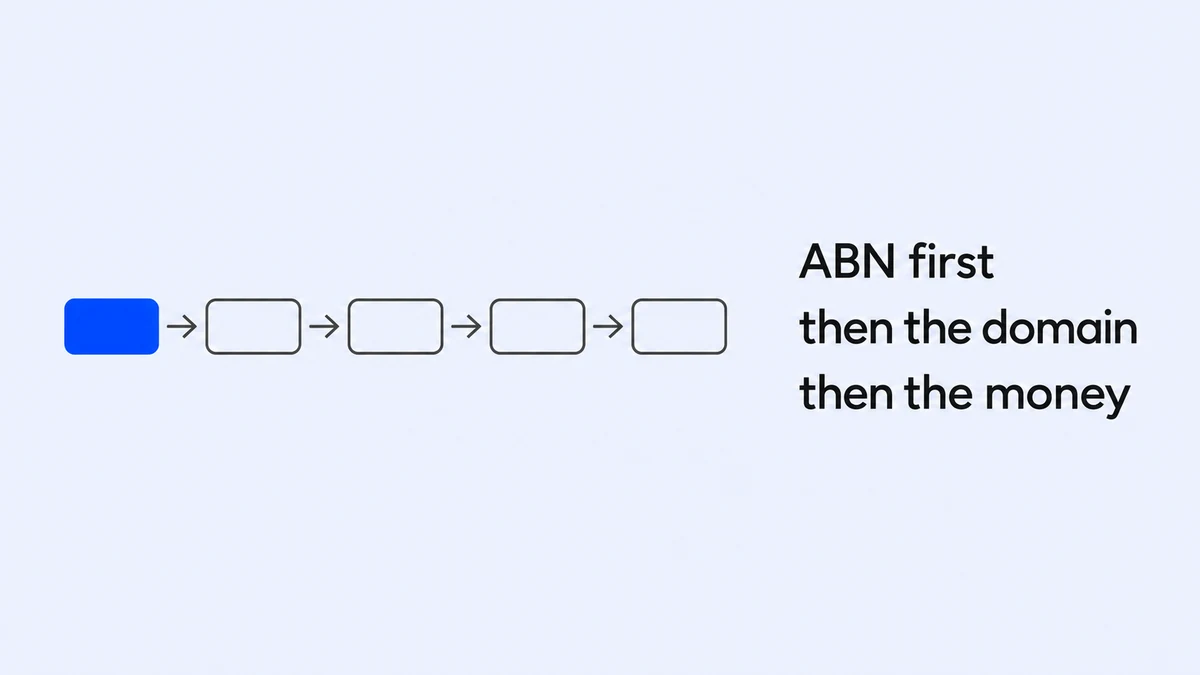
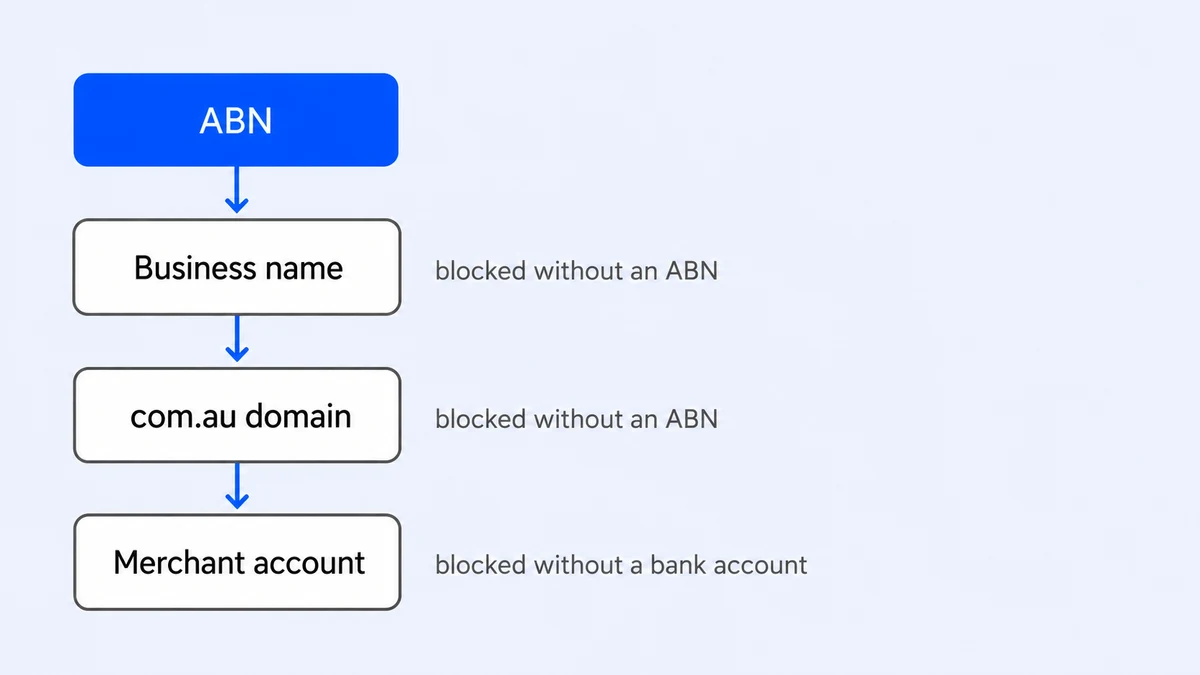
The four things below are not a checklist you can work through in any order. Each
one blocks the next.
An ABN. Free from the Australian Business Register. It identifies your business
to the tax system, to suppliers, and to the domain registry. Everything else in this
list depends on it.
A registered business name, if you trade under anything other than your own name.
Registered with ASIC. If you are Sarah Chen and you sell as Sarah Chen, you can skip
this. If you sell as Harbour Ceramics, you cannot.
A .com.au domain. The auDA licensing rules
require the holder to be a “Commercial Entity”,
which for a sole trader means holding an ABN, and require the domain name itself to
match your company, business or personal name, your trade mark, or the goods and
services you sell. That second requirement catches people out. You cannot register
a keyword-rich domain that has nothing to do with your registered name unless it
describes what you actually sell.
A bank account and a payment account. Merchant facilities and platform payment
accounts ask for an ABN and an Australian business bank account. Applying for these
before the ABN exists is the most common way to lose a week.
The pattern is easy to miss because each step on its own is simple. It is the
sequence that costs time when you get it wrong. Registering the domain before the
business name is how stores end up with a domain that does not match the name on
their invoices.
The ABN, and what you cannot do without one
An ABN is an eleven digit number issued by the
Australian Business Register.
It is free to apply for, online or on paper. If your details can be verified you usually
see the number immediately on finishing the form. If something cannot be verified,
the application goes to manual processing and can take up to 28 days, which is the
reason to do this first rather than the week before launch.
Three things depend on it directly.
The domain. Covered above. No ABN, no .com.au, unless you are a company or an
incorporated association.
GST registration. The Australian Taxation Office
is explicit: “Before you register, you need to have an Australian business number (ABN).”
Getting paid in full. If you supply goods or services to another business and
do not quote an ABN, the payer may be required to withhold tax from the payment at
the top rate. For a store selling to consumers this matters less, but the moment
you sell wholesale or take on a stockist, it matters immediately.
Sole trader or company is a separate question, and it is one for an accountant
rather than a web studio. What we can say is that it changes nothing about the
order above. Both need an ABN, and a company needs an ACN first.
GST: the $75,000 line and what it does to your prices
The threshold is $75,000 of turnover in a twelve month period, or $150,000 for
non-profit organisations. Two tests apply: your current turnover, meaning this
month and the previous eleven, and your projected turnover, meaning this month and
the next eleven. Cross either one and you must register within 21 days.
Below the threshold, registration is optional. Registering voluntarily lets you
claim GST credits on what you buy, which suits a store with heavy startup purchases,
but it also means adding 10 per cent to every sale from day one. That is a real
decision, not a formality, and it is easier to make before you have published a
price list than after.
What it changes on the storefront is simple and often skipped. Australian retail
prices are shown to consumers with GST included, so your product pages show the
final number a buyer pays. If you are registered, your tax invoices must carry your
ABN and show the GST amount. If you are not registered, you cannot charge GST at all,
and your invoices should not imply that you have.
For clarity on our own pricing: Web Ways Tech is not registered for GST, so the
prices further down this page are final and there is no tax sitting inside them.
Choosing the platform, in one decision
The platform question gets written about as though it were a features comparison.
For a first store it is a simpler question: who is going to look after this thing
in six months?
A hosted platform like Shopify or BigCommerce includes hosting, updates and security
in the monthly fee. You trade control and a per-sale cost for not having to think
about maintenance. WordPress with WooCommerce puts hosting, updates and backups on
you or on whoever you pay to do it, and in exchange the store is yours to change
without restriction. Australian sellers on the Whirlpool forums frame the trade the
same way, and generally conclude that WooCommerce works out cheaper over several
years even after paying for development help.
If you are weighing a hybrid setup, where WordPress does the content and Shopify
does the checkout, we have written that comparison separately in
Shopify WordPress integration.
Taking payment: what to decide before launch
Four decisions, and none of them can wait until the week you go live.
Who processes the payment. The platform’s own payment product, a gateway like
Stripe, or a bank merchant facility. Each has a different per-transaction cost and
a different settlement time.
Which methods you accept. Cards, PayPal, Apple Pay and Google Pay, buy now pay
later. Each extra method adds a fee and a small amount of checkout complexity.
Who absorbs the fee. This one has a deadline. From 1 October 2026 the
Reserve Bank’s reforms
remove card surcharging on eftpos, Mastercard and Visa, across debit,
credit and prepaid. American Express is taking part voluntarily. The change covers
surcharges added because a customer paid by card, and not weekend or public holiday
surcharges or booking fees. In practice a new store cannot plan on passing card costs
to the customer at checkout. That cost goes into your prices or into your margin, and
it is easier to price for it now than to reprice in October.
How refunds are issued. Back to the original payment method is the default
expectation. Store credit as the only option is a problem, for reasons covered in
the next section.
The pages Australian Consumer Law expects your store to carry
Consumer guarantees apply automatically to almost everything sold to consumers in
Australia. They are not a warranty you offer. They exist whether or not you mention
them, and your policies cannot cut them down.
The ACCC
puts it plainly: a business cannot take away these rights by “displaying
a ‘no refunds’ sign, or otherwise saying that refunds are not available at all, or
not available at all after a certain number of days”.
That single sentence rules out most of what stores actually write. Here is what
belongs on each page instead.
Returns and refunds. Separate change of mind from faults, and say so. You are
free to refuse a change of mind return, or to offer store credit for it, or to set
a fourteen day window for it. You are not free to apply any of that to goods that
are faulty, unsafe or not as described. The phrase that keeps stores out of trouble
is short: “for change of mind”.
Delivery. How long dispatch takes, how long delivery takes, and what happens
when a parcel goes missing. Buyers look for this before they add to cart, and only
some stores answer it.
Contact details. A form is not enough on its own. A phone number or a postal
address tells a buyer there is a real business behind the site.
Privacy. You are collecting names, addresses and order histories at checkout.
The Privacy Act
does not cover most businesses turning over $3 million or less,
though there are exceptions, including health service providers and any business
that trades in personal information. Reform of that exemption has been announced
without a settled commencement, and published commentary disagrees on both the
timing and the scope, so check your own position rather than relying on a blog.
Publishing a privacy policy costs nothing either way, and it answers the question
a buyer is actually asking, which is what happens to their address.
Terms of sale. Pricing, payment, delivery, cancellation. This is the contract
the order is made under.
One more thing is coming. The Competition and Consumer Amendment
(Unfair Trading Practices) Act
received assent on 6 July 2026 as Act No. 64 of 2026. It adds a
prohibition on unfair trading practices, rules on drip pricing, and requirements for
subscription contracts including an online cancellation option. Those obligations are
not in force yet, and legal commentary puts the start at 1 July 2027. Compliance blogs
have already begun describing parts of it as current law, so check the commencement
date before you rebuild anything. What is worth doing now regardless: show the full
price early rather than adding fees at the last step, and offer a guest checkout.
Retrofitting either one costs more than building it in.
What thirty Australian stores actually publish
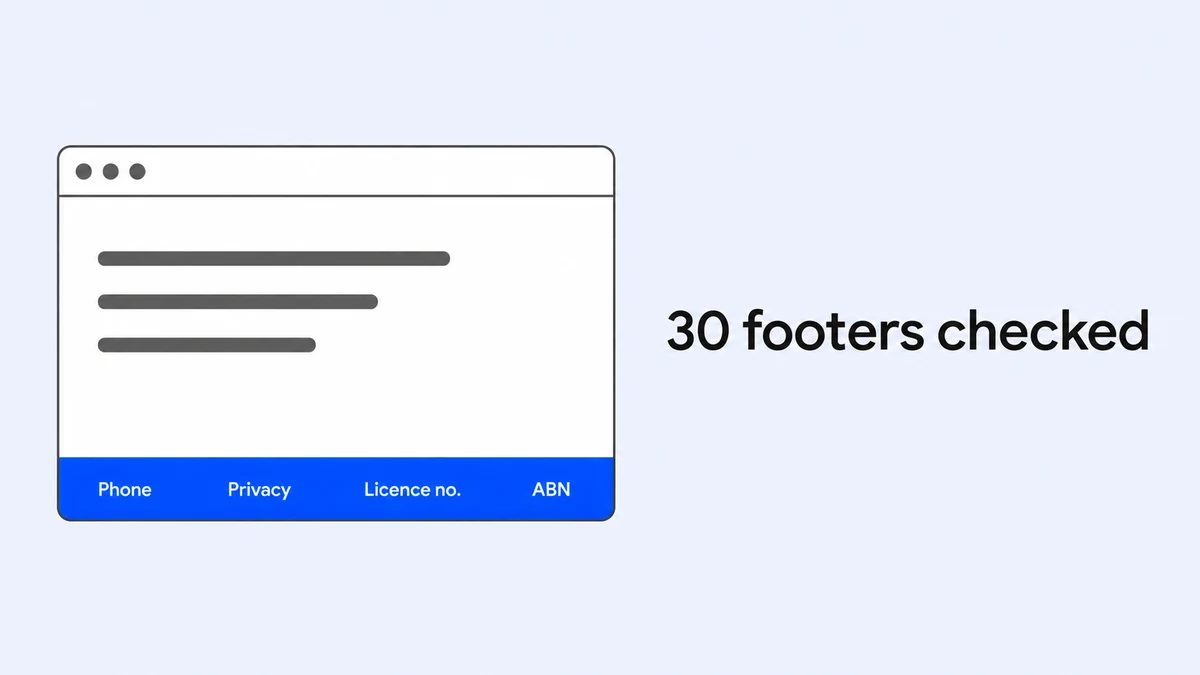
We measured thirty small Australian online stores in September 2026, three in each
of ten categories: candles, jewellery, skincare, coffee, homewares, plants, leather
goods, stationery, clothing and hot sauce. Chains, marketplaces and major retailers
were excluded. The crawler visited 246 pages and kept a quote for every marker it
found, and every positive was read by a person before it was counted.
| What a buyer can find | Stores | Share |
|---|---|---|
| Returns policy page | 28 | 93% |
| Privacy policy | 28 | 93% |
| Terms and conditions | 28 | 93% |
| Product search | 27 | 90% |
| Phone number or postal address | 26 | 87% |
| Delivery times in days | 18 | 60% |
| ABN shown anywhere on the site | 8 | 27% |
| A statement that prices include GST | 1 | 3% |
Nearly every store has the pages. The pages are where the problem is.
Of the 28 stores with a returns policy, nine used wording that limits a buyer’s
rights when goods are faulty or not as described. Three said sale items cannot be
refunded, with no exception for faults. One said refunds are not available at all
and offered store credit instead. One asked buyers to report “damaged, or faulty
items” within seven days. One promised a refund when an item is “not as it was
described” only “within 14 days” of purchase. One ruled out returns on its product
entirely once an order was dispatched.
Five other stores in the same sample wrote the identical restriction correctly, by
attaching it to change of mind. The difference between a policy the ACCC has warned
about and a policy that is fine is three words.
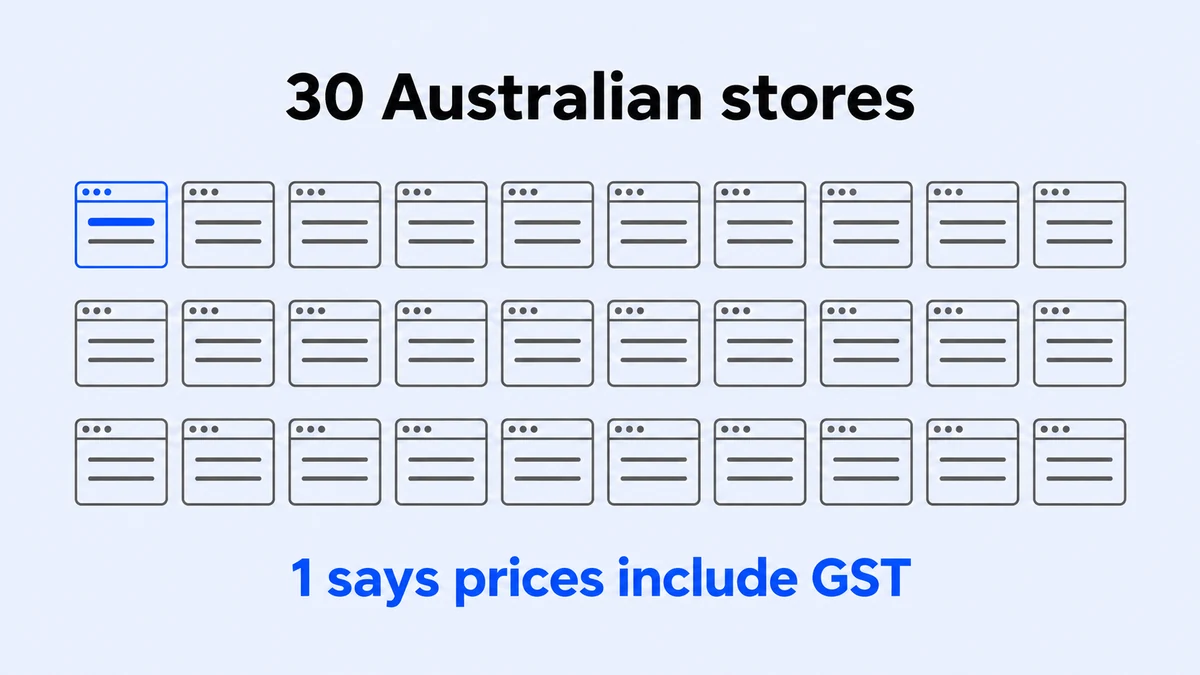
Two more findings are worth your attention. Delivery timeframes in days appear on
18 of 30 stores, so four in ten give a buyer no answer to the most common
pre-purchase question there is. And exactly one store out of thirty tells buyers
that displayed prices include GST, in a market where retail prices are expected to
include it.
A note on method, because it changed the result. The first crawl reported that seven
stores had no returns policy at all. Checking by hand showed six of the seven had
one sitting at the platform’s default address, which the crawl had not reached. The
script was fixed and the number moved from 23 to 28. Automated measurement without
reading the quotes would have produced a confident and wrong finding.
What it costs to build, and what you keep paying
Two different numbers get confused here. There is the cost of having the store built,
which is once, and the cost of running it, which is forever.
Our ecommerce packages are $1,950 for a Quick Launch store of up to 10 products,
typically one to two weeks; $3,900 for a Growth Shop of up to 50 products with
collection pages and product page optimisation, two to three weeks; and $6,900 for
Advanced Functionality with up to 150 products, filters, abandoned cart recovery
and email platform integration, four to six weeks. Full detail sits on the
ecommerce website development page.
Three costs continue after launch regardless of who builds the store: the platform
subscription or the hosting bill, the payment processing fee on every sale, and the
domain renewal. None are large on their own. Together they set the floor under your
margins, and they are the numbers most first-time owners have not written down.
What moves a store from the lower number to the higher one is rarely design. It is
product count, integrations with accounting or inventory systems, and how much
content has to be written. If your catalogue is 20 products and your supplier sends
you photographs, you are at the lower end. If it is 150 products with variants and
nobody has written a description yet, you are not.
If you are still deciding whether you need a store at all, our
website design packages cover the simpler case, and
what a website costs in Australia breaks the numbers
down further.
| Task | Usually you | Usually us |
|---|---|---|
| ABN, business name, GST registration | yes | no |
| Choosing the platform | with advice | we advise |
| Product photography and descriptions | yes | can be quoted |
| Store build, checkout, shipping rules | no | yes |
| Payment account application | yes, it is in your name | we connect it |
| Returns, privacy and delivery pages | you decide the terms | we build the pages |
| Launch checks and training | no | yes |
Frequently asked questions
How much does it cost to start an online store in Australia?
The ABN is free. A business name registration costs an ASIC fee, paid for one or
three years and indexed each July. A .com.au domain is a modest annual cost that
varies by registrar. From there the build is the variable:
between $1,950 and $6,900 with us, depending on product count and functionality.
Then budget for the platform subscription and payment fees every month afterwards.
Do I need an ABN to sell online?
To register a .com.au domain, to register for GST, and to open most merchant
accounts, yes. You can sell through a marketplace without one in some situations,
but a standalone Australian store is not practical without it.
Do I have to register for GST straight away?
Only once your turnover reaches $75,000 in a twelve month period, and then within
21 days. You can register voluntarily earlier, which lets you claim GST credits on
purchases but adds 10 per cent to your prices.
Can I start an online store for free?
You can start a trial for free. You cannot run a business on one for long. The
unavoidable costs are the domain, the platform or hosting, and payment processing.
What is the easiest way to start an online store in Australia?
Get the ABN, register the business name if you need one, secure the domain, then
choose the platform. Doing those four in that order removes most of the delays that
catch people out.
Do I need a privacy policy on a small online store?
The Privacy Act currently exempts most businesses under $3 million in turnover, and
reform of that exemption has been announced without a settled commencement. Publish
one regardless. You are collecting addresses at checkout, and buyers ask what happens
to them.
Where to start this week
Apply for the ABN today. It is free and it unblocks everything else. Register the
business name if you trade under one, then secure the domain while the name is fresh.
Decide the GST question with your accountant before you set prices rather than after.
Then write your returns policy yourself, in your own words, before anyone builds you
a page for it. Say what you will do about change of mind, say what you will do about
faults, and keep those two things apart. Nine of the thirty stores we looked at got
that wrong, and it is the cheapest mistake on this page to avoid.
When you are ready to build, tell us what you are selling and we will
tell you which of the three packages fits.
This article is general information about starting a retail business in Australia and is not legal, tax or accounting advice. Thresholds, fees and obligations change: check the current guidance at abr.gov.au, ato.gov.au, asic.gov.au, accc.gov.au, oaic.gov.au and auda.org.au, and speak to your own accountant before you rely on anything here. The removal of card surcharging from 1 October 2026 is as announced by the Reserve Bank of Australia in its March 2026 conclusions paper. The measurement of thirty Australian stores is our own, and its method and limits are described in the article.