If you have been searching for the NDIS Price Guide 2026-27 and finding documents that do not match, you are not doing it wrong. The document you are looking for no longer exists under that name.
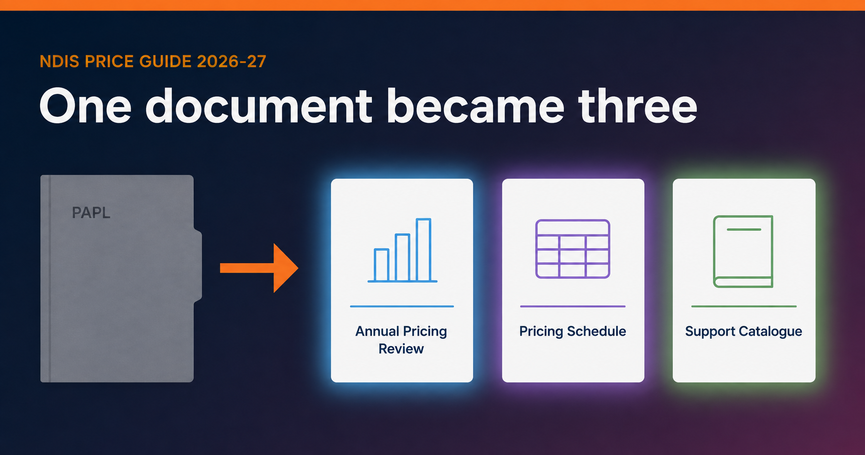
On 1 July 2026 the NDIA stopped publishing the single NDIS Pricing Arrangements and Price Limits. In its place there are now three separate publications, one of which has not been reissued at all. Most guides written about this landed in July. Since then a new version of the pricing schedule has been published, and an Act of Parliament has passed that changes who sets NDIS prices in the first place.
This guide covers what replaced the price guide, what the current NDIS prices are, and which pages on your own website are now out of date.
Key takeaways
- The NDIS Price Guide and the PAPL are gone as a single document. There are now three: the Annual Pricing Review, the NDIS Pricing Schedule and the NDIS Support Catalogue.
- The current NDIS Pricing Schedule is version 1.2, published 22 July 2026. Most guides online were written against version 1.0 or 1.1.
- The standard weekday daytime support worker price limit is $73.58 an hour nationally, $103.01 in remote areas and $110.37 in very remote areas.
- The claiming rules for support workers, nursing and support coordination were not republished for 2026-27. There is no addendum.
- The Securing the NDIS for Future Generations Act passed on 19 August 2026 and gives the Minister power to set binding prices. The NDIA’s own current documents still describe it as a proposal.
- From 1 January 2027 the recommended prices for Social, Community and Civic Participation supports drop 10 per cent for unregistered providers only.
What happened to the NDIS Price Guide
The NDIS Price Guide has not been called that officially for years. It became the NDIS Pricing Arrangements and Price Limits, usually shortened to PAPL, and most people kept saying price guide anyway. That was harmless while there was one document behind both names.
For 2026-27 there is no single document. The NDIA split it into three, and each one does a different job.
The Annual Pricing Review. A 186 page report explaining what the NDIA thinks prices should be and why. This is where the reasoning lives: the benchmarking, the market data and nineteen numbered recommendations. Almost nobody reads it, and it is the most useful of the three.
The NDIS Pricing Schedule. A 99 page set of price tables, effective 1 July 2026. It tells you the maximum price for each item across eleven schedules, from Disability Support Workers through to Isolated Towns Modification Lists. It replaced the price tables that used to sit inside the PAPL.
The NDIS Support Catalogue. Support item numbers and claim types, so your software knows what to send.
What none of them contain is the claiming rules. More on that below, because it is the part that will cost you money.
Which name to use where
This matters more than it sounds, because your participants and referrers are still searching the old term.
| If you mean | Say | Do not say |
|---|---|---|
| The current price tables | NDIS Pricing Schedule 2026-27 | NDIS Price Guide 2026-27 |
| Item numbers and claim types | NDIS Support Catalogue | Price guide |
| The reasoning and recommendations | Annual Pricing Review | Price review |
| The old combined document | The 2025-26 PAPL | The current PAPL |
Where to download the official documents
The NDIA publishes all of these from its pricing arrangements page. The direct downloads are:
- NDIS Pricing Schedule 2026-27, PDF, about 1.3MB
- Annual Pricing Review for 2026-27 prices, PDF, about 5.9MB
- Both are also published as Word documents from the same page
Check the version before you rely on anything. Page 4 of the pricing schedule carries a version control table, and it has changed three times already.
| Version | Published | What changed |
|---|---|---|
| 1.0 | 22 June 2026 | Initial publication |
| 1.1 | 3 July 2026 | Corrected line item numbers for the new psychology and exercise physiology items |
| 1.2 | 22 July 2026 | Clarifying text for provisional psychology claiming, and typographical corrections |
Anyone who downloaded the schedule in early July has version 1.0 or 1.1. Nearly every guide published about the 2026-27 changes was written against those, which is why you will see conflicting line item numbers in blog posts.
A correction worth making while you are here. Several industry summaries reported that version 1.1 of the pricing schedule added a missing SIL provider travel item. It did not. That change was to the Support Catalogue, which has its own version numbering. The two documents are updated separately and mixing them up will send you looking for an item that is not there.
The 2026-27 price limits, and where they moved
Support worker prices rose. Therapy went in three different directions. The coordination and plan management fees did not move at all.
Support worker price limits
These come from Schedule 1 of the pricing schedule, item 01_011_0107_1_1 and its siblings. All figures are the national maximum, with the remote and very remote loadings alongside.
| Support | National | Remote | Very remote |
|---|---|---|---|
| Weekday daytime | $73.58 | $103.01 | $110.37 |
| Weekday evening | $81.07 | $113.50 | $121.61 |
| Weekday night | $82.57 | $115.60 | $123.86 |
| Saturday | $103.54 | $144.96 | $155.31 |
| Sunday | $133.50 | $186.90 | $200.25 |
| Public holiday | $163.46 | $228.84 | $245.19 |
| Night-time sleepover, per shift | $311.79 | $436.51 | $467.69 |
Remote adds 40 per cent to the national price limit. Very remote adds 50 per cent. If your website quotes one hourly rate with no mention of location, it is wrong for a large part of the country.
You will find $70.23 quoted as the new weekday rate in several places online. That figure is the 2025-26 price limit reported as though it were current.
Therapy prices went three ways
The Annual Pricing Review benchmarked therapy prices against the Medicare Benefits Schedule and private health insurance data, then adjusted for session length.
Psychology rose to $252.99 an hour, applied uniformly across all jurisdictions.
Dietetics fell to $178.99 an hour. The review put the private health 75th percentile at $155.00 and the MBS 75th percentile at $152.00. Its own wording is that the divergence was large and consistent enough to justify moving the NDIS price toward a more appropriate level while limiting market disruption. This is the second annual reduction for dietitians.
Exercise physiology fell to $161.99 an hour, benchmarked against an MBS 75th percentile of $152.00 and a private health figure of $132.00.
Occupational therapy, speech pathology, physiotherapy, podiatry and audiology were left alone. The full set of direct service price limits now reads like this.
| Discipline | National | Remote | Very remote |
|---|---|---|---|
| Psychology | $252.99 | $354.19 | $379.49 |
| Occupational therapy | $193.99 | $271.59 | $290.99 |
| Speech pathology | $193.99 | $271.59 | $290.99 |
| Audiology | $193.99 | $271.59 | $290.99 |
| Podiatry | $188.99 | $264.59 | $283.49 |
| Physiotherapy | $183.99 | $257.59 | $275.99 |
| Dietetics | $178.99 | $250.59 | $268.49 |
| Exercise physiology | $161.99 | $226.79 | $242.99 |
Two new price points appeared. Orientation and Mobility Specialists get dedicated items at $156.16 an hour, following recognition by the NDIS Quality and Safeguards Commission. The Other Professionals category is also set at $156.16.
Support coordination and plan management stood still
| Support item | Price limit |
|---|---|
| Level 1: Support Connection | $80.06 per hour |
| Level 2: Coordination of Supports | $100.14 per hour |
| Level 3: Specialist Support Coordination | $190.54 per hour |
| Plan Management, monthly fee | $104.45 per month |
Levels 2 and 3 have now held for six consecutive years. It is also the only support in the schedule published with no remote or very remote loading at all, which is worth knowing before you quote a regional participant.
The review does explain why it is watching this market. The service reached more than 291,800 participants in the six months to December 2025, around 38 per cent of active participants. Growth is coming from small new entrants rather than existing providers scaling up: roughly 3,000 providers supported a single participant each, with average claims of $2,000. The NDIA has recommended reviewing the plan management pricing approach, so this is unlikely to be the last word.
The claiming rules nobody replaced
Here is the part that costs money.
The old PAPL did two jobs. It listed prices. It also set the rules for claiming them: how much provider travel you could bill, when non-face-to-face time was claimable, how short notice cancellations worked, and what conditions applied to NDIA-requested reports.
The pricing schedule does the first job. Nothing does the second.
For allied health there is a replacement of sorts. The review recommended breaking travel and non-face-to-face work out of the claim type system and giving each its own line item. That is why allied health items now carry suffixes: _PT for provider travel, _NF for non-face-to-face, _RR for requested reports, _CA for cancellations and _TH for telehealth. The rule is now built into the item number.
For disability support workers, nursing and support coordination, the rules were simply removed. No addendum has been published to replace them.
The working position across the sector has three parts. Apply the 2025-26 claiming rules. Price the claim at the 2026-27 limit. Then keep a written note of your basis for anything involving travel, non-face-to-face time or a cancellation. That is a reasonable reading rather than a published rule, which is exactly the problem.
Watch out for a common shortcut too. You will see the change described as “0115 becomes 0138”. Registration group 0138 is the new SIL group, and SIL claims under 0115 will be rejected for services delivered after 1 July. But 0115 has not disappeared. Short Term Accommodation items in Schedule 1 still carry it, including 01_200_0115_1_1 and everything below it. Change the codes that changed, not all of them.
The Act that passed after everyone stopped reading
Almost every guide to the 2026-27 changes was written in July. Something significant happened in August.
The National Disability Insurance Scheme Amendment (Securing the NDIS for Future Generations) Bill 2026 was introduced on 14 May 2026. It passed both Houses on 19 August 2026 and received assent on 20 August as Act No. 66 of 2026.
The Act amends the NDIS Act 2013 in two connected ways. The Minister for the NDIS gains the power to make a pricing determination, setting the maximum amount for a support. The NDIA gains a formal function of advising the Minister for that purpose.
That is a real shift. Today the pricing schedule is guidance about appropriate prices. Under a ministerial pricing determination, maximum prices become binding.
The detail worth sitting with is that the NDIA’s own live documents have not caught up. Page 3 of the current pricing schedule still describes the Bill as something that “proposes” to amend the Act, and says what will happen “if the Bill is subsequently passed”. The pricing updates page carrying the same language was current as at 22 July. Both were accurate when written and neither has been revised since assent.
What changes on 1 January 2027
Recommendation 16 of the review is the one to diarise:
The prices for Social, Community and Civic Participation supports delivered by unregistered providers, including high intensity supports should be reduced by 10 per cent from 1 January 2027. Indexation of these supports should be ceased. The prices and indexation for Social, Community and Civic Participation supports delivered by registered providers should be maintained.
The review is explicit that the differential applies across standard and high intensity items and carries through to non-face-to-face claiming, provider travel, short notice cancellations and activity-based transport. It also states the NDIA will monitor the effect on registration rates, which tells you plainly what the measure is for.
Be careful how you read it. This is a recommendation in an advisory report, not a rule in force. What makes it worth planning around is the combination: the recommendation sets out the NDIA’s position, and Act 66 gives the Minister the power to make that position binding.
What this changes on your own website
Every guide above this line tells you how to reconfigure your billing software. None of them mention the pages your participants and referrers actually read. If you publish prices, the 1 July change has already made some of them wrong.
Work through these:
- Any published hourly rate. If a page still shows $70.23 or last year’s figures, it is understating what you charge. If it shows a single national figure and you deliver in remote areas, it is understating it by up to 50 per cent.
- Your service agreement page. The pricing schedule is direct on this: providers must discuss proposed changes to existing service agreements with participants, and participants must agree before the changes are made. Discuss and agree, not notify. If your page says you will advise participants of price updates, it describes something weaker than what is required.
- Cancellation terms. If your policy page explains short notice cancellations as a modifier or claim type, that language no longer matches the allied health items, which now carry a
_CAsuffix. - Any downloadable price list or PDF. These are the worst offenders because nobody remembers they are there. Search your own media library.
- Support item codes in page text. SIL descriptions referencing 0115 need to move to 0138. Short Term Accommodation descriptions do not.
- Your registration status. If you are unregistered and deliver Social, Community and Civic Participation supports, the January 2027 recommendation affects your pricing directly, and participants comparing providers will start asking.
Working through provider registration and audit evidence at the same time? Our NDIS audit checklist covers the documents side, and accessibility on an NDIS website covers what the law requires of the site itself.
Frequently asked questions
Is the NDIS Price Guide the same as the Pricing Arrangements and Price Limits?
It was. The price guide became the PAPL, and both names described one document. For 2026-27 that document no longer exists. The price tables are now in the pricing schedule, the item numbers are in the Support Catalogue, and the reasoning is in the Annual Pricing Review.
What is the difference between the NDIS Pricing Schedule and the Support Catalogue?
The pricing schedule tells you the maximum price you can charge for a support. The support catalogue tells you the item number and claim type to use when you claim it. You need both to submit a correct claim.
Where can I download the official NDIS Pricing Schedule 2026-27?
From the NDIA pricing arrangements page, or directly as a PDF. Check page 4 for the version number. The current version is 1.2, published 22 July 2026.
How much did NDIS prices go up on 1 July 2026?
Support worker price limits rose, with the standard weekday daytime rate now $73.58 an hour nationally. Therapy moved in both directions: psychology up to $252.99, dietetics down to $178.99, exercise physiology down to $161.99. The coordination and plan management fees did not change.
Why have support coordination rates not increased?
Levels 2 and 3 have been held at $100.14 and $190.54 for six years running. The NDIA has recommended a review of the plan management pricing approach and is monitoring that market, where about 3,000 providers currently support a single participant each.
Do the new NDIS prices differ for unregistered providers?
Not yet. That changes in January. From 1 January 2027 the review recommends a 10 per cent reduction for Social, Community and Civic Participation supports delivered by unregistered providers, with indexation ceased. Registered providers are maintained.
Do I need participants to agree to new prices before they apply?
Yes. The pricing schedule states that providers must discuss proposed changes to existing service agreements with participants and that participants must agree to the changes. Agreement is required, not notification.
Does the new Pricing Schedule replace the PAPL permanently?
For price tables, yes. For claiming rules, there is currently no replacement. The rules covering provider travel, non-face-to-face time and short notice cancellations for support workers, nursing and support coordination have not been reissued, and no addendum has been published.
Getting your site to match the schedule
Price changes are the easy part. The hard part is where the numbers live. A pricing page, a services page, a service agreement, a PDF somebody uploaded two years ago, and often a line in the footer.
We build websites for NDIS providers where the published numbers sit in one place and can be updated without a developer. The NDIS package is $2,700, which is our Standard $2,000 build plus $700 for the provider-specific work, and it includes writing the pages.
If your prices changed on 1 July and your website still has not, talk to us about your NDIS website or book a call and we will go through what needs updating.
This article explains published NDIS pricing documents and is general information, not legal or compliance advice. Prices and rules change: check the current version of the pricing schedule at ndis.gov.au before you rely on any figure here. Figures cited are from the pricing schedule 2026-27 version 1.2 and the Annual Pricing Review for 2026-27 prices, both published by the NDIA.