Ninety two per cent of rated education and care services in Australia sit at Meeting National Quality Standard or above. A year earlier it was 91 per cent. It means the rating that once separated a good service from an average one now separates almost nobody, because almost everybody has it.
A family still has to choose. They open StartingBlocks and see your rating against the national quality standards. Next to it sit four other centres with the same one. So they go looking for whatever tells you apart, and usually that is your website.
This guide covers what the National Quality Standard measures and what your rating looks like from the family’s side of the screen. It then works through the 40 elements to find the ones a parent can actually read.
Key takeaways
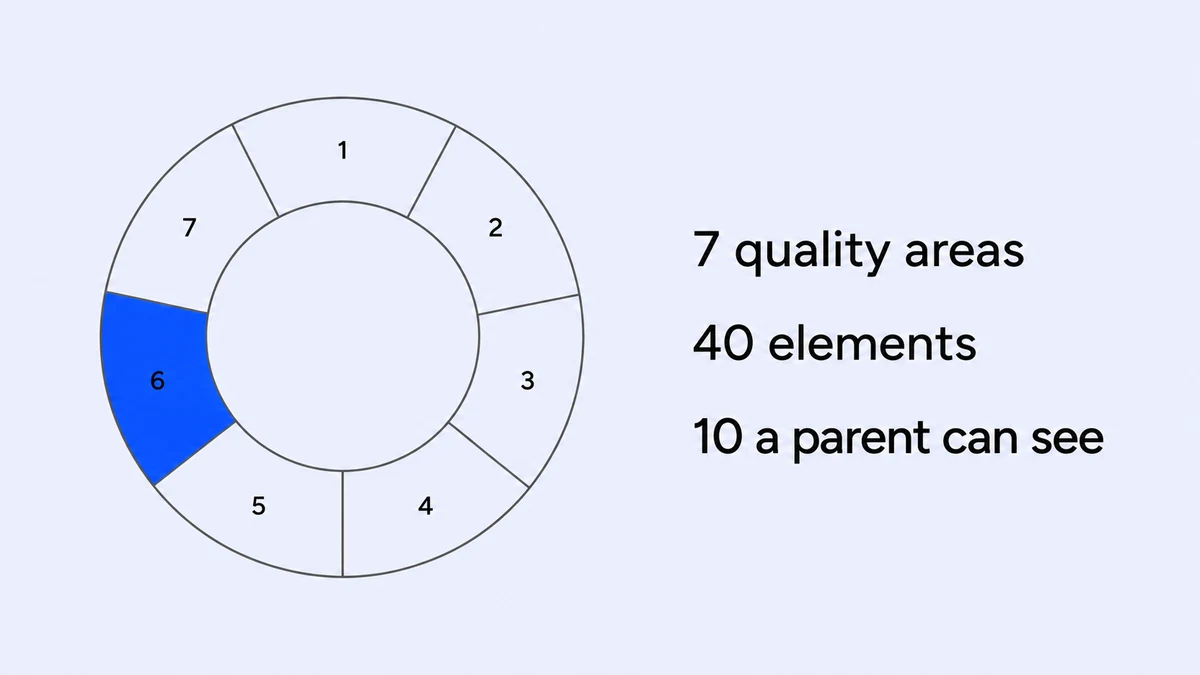
- The NQS is assessed across seven quality areas, 15 standards and 40 elements. Services get a rating for each quality area and an overall quality rating.
- At 1 July 2026, 73 per cent of rated services were Meeting NQS and 19 per cent Exceeding NQS. Twenty five services in the country hold Excellent.
- Ten of the 40 elements describe things families receive, read or are told. Those are the ones a website can show.
- Quality Area 6, collaborative partnerships with families and communities, is the area services fail least often. It is also one of the four areas that count double towards an Exceeding rating.
- Services come unstuck on internal systems, not on the public part. Element 7.1.2, management systems, is not met by 3.4 per cent of services. Element 6.1.1, engagement with the service, by 0.2 per cent.
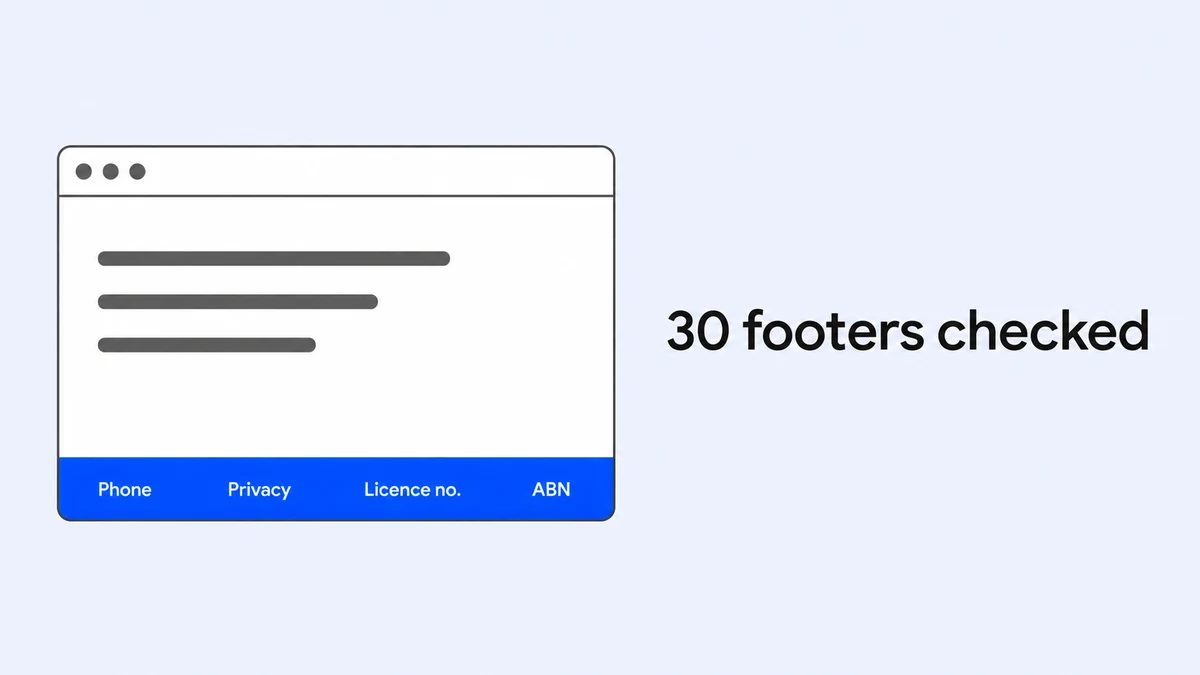
- We checked 30 Australian centre websites in September 2026. Three published their own rating. Twenty three described their transition to school program.
What the National Quality Standard actually measures
An authorised officer works through 40 statements, not seven headings. The National Quality Standard sets a national benchmark for education and care services, and it is assessed across seven quality areas, 15 standards and 40 elements. Authorised officers from your state or territory regulatory authority rate each quality area, then give an overall quality rating.
The seven quality areas are:
- Educational program and practice
- Children’s health and safety
- Physical environment
- Staffing arrangements
- Relationships with children
- Collaborative partnerships with families and communities
- Governance and leadership
Underneath them sit the standards and elements: 15 standards, then 40 short statements describing the outcomes for children that contribute to each one. The elements are where assessment actually happens, and they are far more specific than the quality area names suggest.
The same national quality standards apply to long day care, preschool and kindergarten, outside school hours care and family day care. There are exceptions. Tasmanian preschools and most preschools in Western Australia sit outside the scope of the NQF.
The NQS is one part of the National Quality Framework. The rest of it is the National Law and National Regulations, a nationally consistent assessment and quality rating process, and the approved learning frameworks including the Early Years Learning Framework. A regulatory authority in each state and territory administers it. ACECQA, the Australian Children’s Education and Care Quality Authority, oversees the system nationally.
At 1 July 2026 there were 18,197 approved services operating under the NQF, and 17,131 of them held a quality rating (NQF Snapshot Q2 2026, ACECQA). That is 94 per cent. The gap is mostly new services. In early childhood education and care, a newly approved service is generally assessed and rated within 9 to 18 months of opening.
What your rating looks like from outside
There are five rating levels, and in practice families see three of them.
Of the 17,131 rated services at 1 July 2026, 1,317 were Working Towards NQS, 12,587 were Meeting NQS and 3,193 were Exceeding NQS. Nine were Significant Improvement Required. Twenty five services in the whole country hold Excellent, a rating only ACECQA can award and only to services already rated Exceeding.
Exceeding is harder to reach than the word suggests, and the arithmetic is worth knowing before you promise a family anything. Every quality area has to be at least Meeting. Four or more have to be Exceeding. And at least two of those four have to come from Quality Area 1, 5, 6 or 7 (ACECQA guidance on determining Exceeding NQS). Within a quality area, every standard in it must be Exceeding for the area to be.
Among services that get there, 39 per cent are Exceeding in all seven quality areas and 28 per cent in exactly four. So the label covers a real range, from a service that cleared the bar in four areas to one that cleared it everywhere.
Where a family sees your rating before they see your website
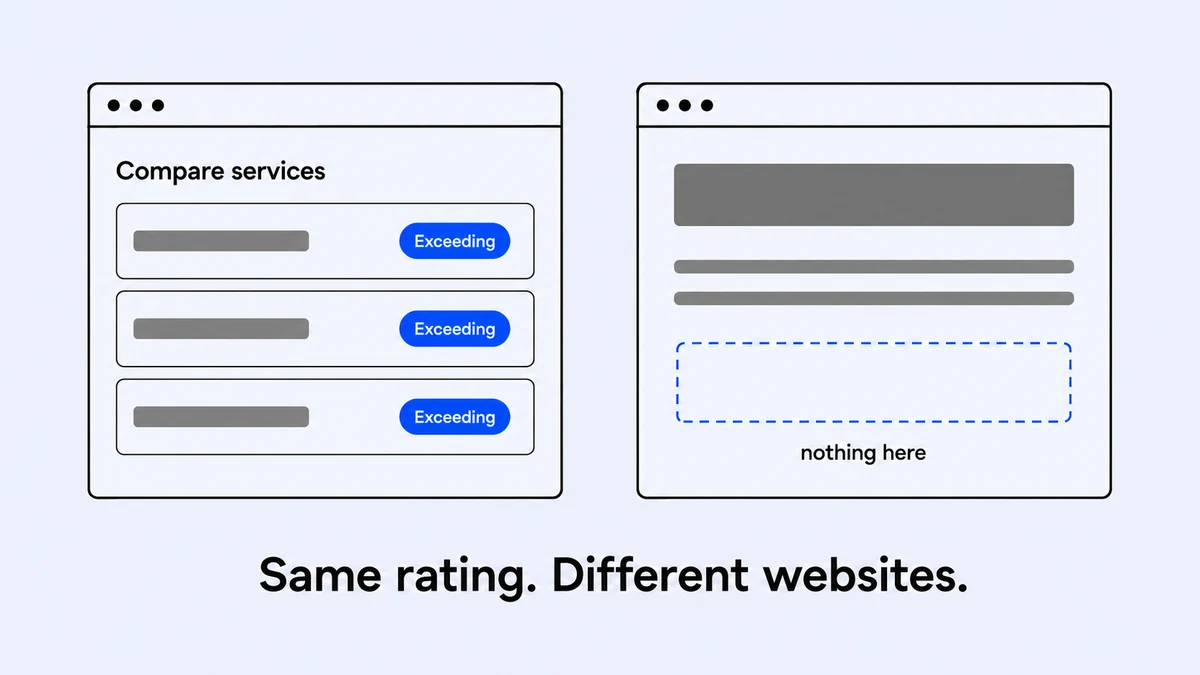
Your rating reaches a family through somebody else’s website first.
StartingBlocks is the government service that lets families find and compare services by quality rating, fees and vacancies. Private comparison sites sit alongside it. KindiCare publishes its own score from NR to 10 and lets families sort by it. That is a commercial rating, not the NQS one. The two sit on the same screen and blur together.
None of those places carry your voice. They carry your rating, your fees, your vacancies and, on the review sites, other people’s opinions. Whatever else you want a family to know has to come from a page you control.
There is one detail about the rating itself that families rarely understand and centres rarely explain: it describes a visit, not today. An overall quality rating stands until the service is reassessed. If yours was issued three years ago, it is a statement about the service three years ago, and any improvement made since then is invisible in the number.
That matters more in 2026 than it did. Regulators are acting far more often. There were 1,540 statutory compliance actions in the June quarter, against 735 in the same quarter a year earlier. Approval cancellations went from 28 to 589. Families read the news, and they arrive at your website with the question already formed.
The ten elements that leave a public trace
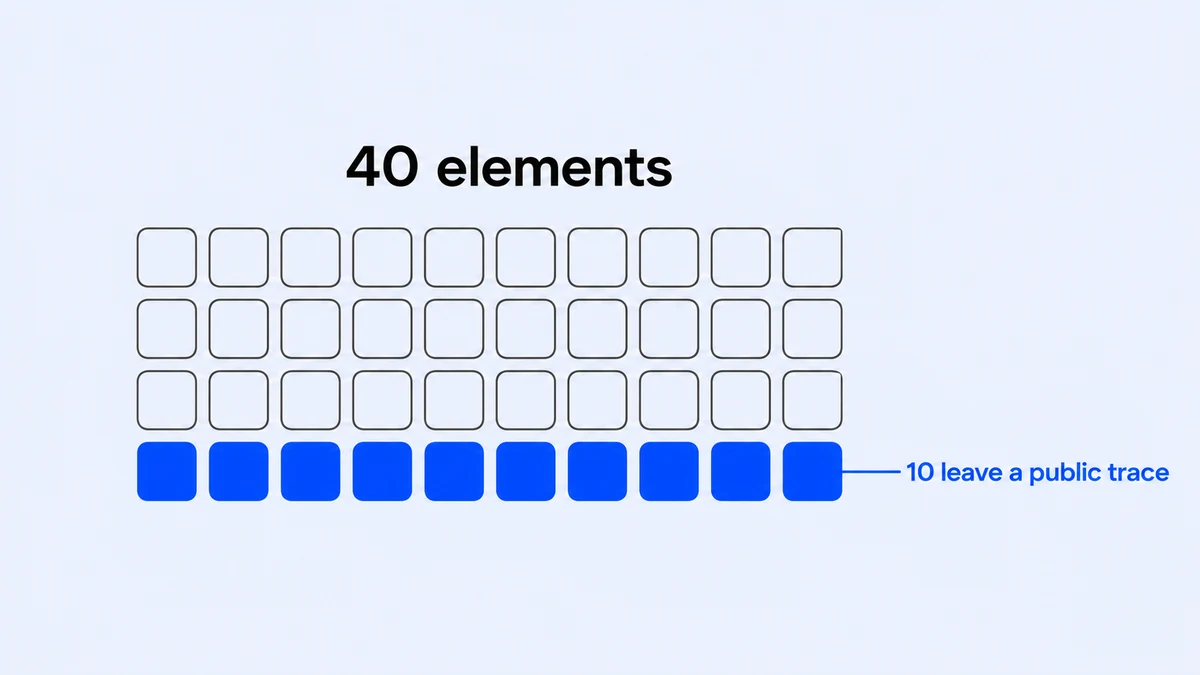
Thirty of the 40 elements describe practice inside the room. A family cannot see whether your assessment and planning cycle runs properly, and no website will show them.
Ten elements are different. They describe things a family receives, reads or is told, so they have a natural home on a website. Here they are, with the wording from the assessment and rating instrument and what the same thing sounds like when a parent asks it.
1.3.3 Information for families. “Families are informed about the program and their child’s progress.” The parent’s version: will I know what my child actually did today? This is your program page and your communication section.
6.1.1 Engagement with the service. “Families are supported from enrolment to be involved in the service and contribute to service decisions.” The parent asks whether they get a say or a newsletter. Your enrolment page answers it.
6.1.2 Parent views are respected. “The expertise, culture, values and beliefs of families are respected and families share in decision-making about their child’s learning and wellbeing.” A family with a specific cultural or dietary need is checking whether you have thought about them before they ring.
6.1.3 Families are supported. “Current information is available to families about the service and relevant community services and resources to support parenting and family wellbeing.” The word “available” is doing real work here, and a resources page is the cheapest way to satisfy it.
6.2.1 Transitions. “Continuity of learning and transitions for each child are supported by sharing information and clarifying responsibilities.” This is the school readiness question every parent of a four year old is already asking.
6.2.2 Access and participation. “Effective partnerships support children’s access, inclusion and participation in the program.” Families of children with additional needs look for this first and often find nothing. If you have written about accessible information for families in another setting, the same thinking applies here.
6.2.3 Community engagement. “The service builds relationships and engages with its community.” Local partnerships, incursions and community programs belong on the site, not only in the newsletter.
7.1.1 Service philosophy and purpose. “A statement of philosophy guides all aspects of the service’s operations.” Your philosophy is the one document families read to work out whether you sound like them.
2.1.3 Healthy lifestyle. “Healthy eating and physical activity are promoted and appropriate for each child.” This is the menu, and the menu is one of the two pages parents open before they book a tour.
2.2.3 Child protection. “Management, educators and staff are aware of their roles and responsibilities regarding child safety, including the need to identify and respond to every child at risk of abuse or neglect.” In the current climate, saying nothing here reads as an omission.
None of this is new work. Every one of those ten elements is something you already do, written down somewhere a family cannot reach.
Quality Area 6 is the one your website can show
Collaborative partnerships with families and communities is the area services fail least often and exceed most often. Of the 17,131 rated services, 164 were Working Towards in Quality Area 6, which is 1 per cent. At the other end, 3,929 were Exceeding in it, which is 23 per cent and the highest of the seven.
Two things follow. The first is arithmetic: QA6 is one of the four privileged areas in the Exceeding rule above, alongside QA1, QA5 and QA7. The second is about evidence. For a standard to be rated Exceeding, practice has to be embedded in service operations, informed by critical reflection, and “shaped by meaningful engagement with families and/or the community”. That third theme is the only one of the three with a public face.
Be clear about what a website cannot do. It cannot lift your rating. An authorised officer assesses practice, in your rooms, against the elements, and no page has ever changed that. What a website does is show the families making a decision this week what your practice already is, in the one area where the standard itself is about them.
Where services actually come unstuck
The public part of the standard is not the part services fail.
Ranked by the share of services rated Working Towards, the weakest quality area is QA7, governance and leadership, with 853 services. QA2, children’s health and safety, is next with 839.
At element level the pattern is sharper. These are the four elements services most often do not meet:
- 7.1.2 Management systems, 3.4 per cent
- 1.3.1 Assessment and planning cycle, 3.2 per cent
- 2.2.1 Supervision, 3.1 per cent
- 1.3.2 Critical reflection, 3.1 per cent
Now compare that with the ten public elements above. Element 6.1.1, engagement with the service, is not met by 0.2 per cent of services. Element 6.1.2 by 0.3 per cent, 6.2.3 by 0.5 per cent, 1.3.3 by 0.7 per cent.
Services are strong on the part families can see and weaker on systems, planning and supervision, which are internal by nature. The practical read: your website should not try to prove your management systems. It should carry the part you are already good at, and which a family currently has no way to check.
If your rating is Working Towards right now, the sector data is on your side. Of 28,639 reassessments, 69 per cent of services previously rated Working Towards improved their overall rating.
What thirty centre websites actually show
We checked this rather than assumed it.
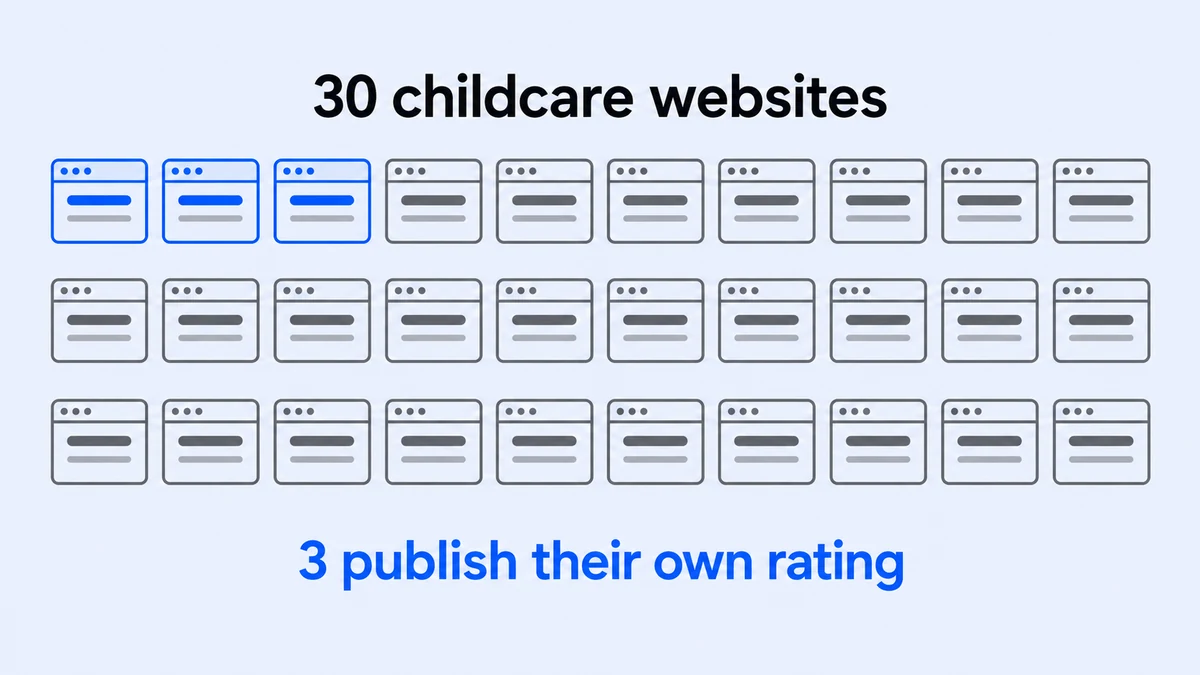
On 4 September 2026 we crawled 31 Australian centre websites: 10 national providers, 10 multi-centre groups and 11 independent or regional services. One site did not respond, so the figures below are out of 30. For each site we read the home page plus up to 12 internal pages, 251 pages in total, and looked for nine markers in the visible text. Every positive result was then read by hand. The automated pass produced false hits, and it was not close: five of the six sites it flagged as publishing a rating date turned out to be saying “founded in 2002”.
The results:
| What we looked for | Sites out of 30 |
|---|---|
| Transition to school described | 23 |
| NQS, NQF or ACECQA mentioned anywhere | 19 |
| Service philosophy published | 14 |
| Menu published or described | 11 |
| Policies section for families | 6 |
| Educator to child ratios given in numbers | 4 |
| Own quality rating published | 3 |
| Quality Improvement Plan mentioned | 2 |
| Date or year of the rating given | 1 |
Twenty three services explain what happens in the year before school. Three tell a family how they were rated. Centres are writing about the thing nobody compares them on and staying quiet about the thing everybody compares them on.
The three that do it are worth copying. Meraki ELC answers it as a question, per service, and says plainly that its Bayswater centre “is a newer centre and has not yet completed its first assessment”. Choices Family Day Care carries “rated ‘Excellent’ by ACECQA 2021”, which is one of the 25 Excellent ratings in the country and the only dated claim in our sample. Kids Club states an Exceeding rating for a named centre.
Two near misses show the trap. One national provider tells a family that “several” of its centres have an Exceeding rating, which leaves the family no wiser about theirs. Another publishes a strong number, 94 per cent of its centres at Meeting or Exceeding, on the page aimed at owners thinking of selling their centre. The families’ pages do not mention a rating at all.
A note on what this measurement is: 31 sites chosen from search results, not a random sample of 18,197 services, and a crawl 12 pages deep. A blank means we did not find it on the pages we read. It says nothing about the quality of any service, only about what its website shows.
What to publish, in order
If you are deciding what to change first, work down this list.
- Your current rating, with the date it was issued, on the page families land on. If it is Working Towards, publishing it with what you changed since is stronger than silence, and 69 per cent of services in that position improve at reassessment.
- Your philosophy, as a page rather than a PDF.
- Your menu, current and dated.
- Your policies, or at minimum a page saying which ones exist and how to get them.
- Your ratios, in numbers, by age group.
- Your transition to school program, which most services already have.
If you want this built rather than listed, our childcare website design service covers the structure, the copy and the pages above. The website design packages page has what a build includes and what it costs. If you are comparing quotes, we have written separately about what a website costs in Australia.
Frequently asked questions
What is the difference between the National Quality Framework and the National Quality Standard?
The National Quality Framework is the whole system. It holds the National Law and National Regulations, the National Quality Standard, a nationally consistent assessment and quality rating process, and the approved learning frameworks. A regulatory authority in each state and territory administers it, and ACECQA oversees it nationally. The National Quality Standard is the part services are measured against, and it holds the seven quality areas, 15 standards and 40 elements.
What are the seven quality standards?
There are no seven standards. There are seven quality areas, 15 standards and 40 elements. Each of the 7 quality areas has two standards, except Quality Area 1, which has three. A service is rated against every element, then at standard, quality area and overall level.
Who decides our rating?
Authorised officers from your state or territory regulatory authority assess and rate the service. ACECQA administers the system nationally and is the only body that can award Excellent. Providers see a draft report before the rating is final. Across the sector, 96 per cent of overall ratings are unchanged between draft and final. Another 3.9 per cent move higher.
Does a good website improve our NQS rating?
No. Assessment is based on observed practice, discussion and the documents an authorised officer reviews, not on your website. A website changes who chooses you, not how you are rated. The two connect only in this sense: the material a family wants to see is often material you already hold for Quality Area 6 and Quality Area 7.
Do we have to publish our Quality Improvement Plan?
Not on a website, but further than most services think. The QIP is the service’s continuous improvement document. Under Regulations 31 and 55 it has to be developed within three months of approval and kept on site for inspection, and Regulation 56 requires it to be updated at least annually. ACECQA’s own guidance goes further: the QIP “is required to be made available to families of enrolled children, and families who are thinking of enrolling in your service”. So a prospective family can already ask for it. In our sample of 30 sites, two mentioned a QIP at all. Publishing it is a choice; telling families it exists and how to read it costs one sentence.
Where do families look up our rating?
StartingBlocks is the government site, and it carries the official rating alongside your fees and vacancies. Private comparison sites republish the same rating next to scores of their own invention, which are not NQS ratings and are not checked by anyone. Search your centre by name and see which of the two a family finds first.
The short version
Raising quality across the sector was the point of the standard, and on the sector’s own numbers it worked. That success is exactly why the rating no longer does the job families need it to do when they are choosing between two centres in the same suburb.
- Open your own site and look for the rating, the philosophy, the menu and the ratios. Time yourself.
- Whatever you cannot find in two minutes, a family cannot find either.
- Fix the rating line first. It is one sentence, and 27 of the 30 sites we checked have not written it.
If your website is quiet about all of this, that is the gap worth closing first. Talk through your website needs and we will tell you what is missing before you spend anything.
This article explains the National Quality Standard as published by ACECQA and is general information, not legal or compliance advice. The standard, the regulations and the assessment process change: check the current documents at acecqa.gov.au and with the regulatory authority in your state or territory before you rely on anything here. Figures are from the NQF Snapshot Q2 2026 and the National Quality Standard Assessment and Rating Instrument, January 2026, both published by ACECQA. The website measurement is our own and its method and limits are described in the article.