The National Regulations do not require you to publish your policies on your website. They require you to keep them available at the service, in a form anyone can ask to read.
That surprises a lot of operators, usually in both directions. Some have spent a weekend building a policies page nobody asked for. Others have nothing online and assume they are exposed. Neither is quite right, and the difference matters when a family rings on a Tuesday asking about the illness policy before they accept a place.
We looked at 31 Australian centre websites in September. Eleven publish their policies. Among independent single site centres, it was one out of eleven.
Here is what the regulations actually say, and which policies are worth publishing anyway.
In brief
- The National Regulations do not require a policies web page. Regulation 171 only requires copies to be available at the service, on request.
- Regulation 168 lists eighteen matters your service must have a policy for, once you count the three added to the list after it was written.
- Regulation 172 gives families 14 days’ notice before a policy or fee change that significantly affects them.
- We measured 31 Australian centre websites: 11 publish their policies online, but only 1 of 11 independents does.
- Five policies are worth publishing anyway: fees, enrolment and orientation, illness and infectious diseases, delivery and collection, and digital technologies and images.
What the regulations actually require
Four regulations carry the whole thing. They are short, and they say less than people assume.
Regulation 168 lists the matters your service must have policies and procedures for. Eighteen of them, once you count the three that were inserted into the list after it was written. The penalty attached is $3,300.
Regulation 170 requires the approved provider to take reasonable steps to make sure staff actually follow those policies. A policy nobody reads is not compliance, it is paperwork.
Regulation 171 is the availability rule, and it has two halves. Copies of current policies must be readily accessible to nominated supervisors, staff, volunteers and family day care educators. And copies must be available for inspection at the service premises, at all times the service is educating and caring for children, or otherwise on request. Both halves carry $3,300.
Regulation 172 is the notice rule. Parents must be notified at least 14 days before a change to any policy that may have a significant impact on the care their child receives, or on the family’s ability to use the service. The same 14 days applies to any change affecting fees or the way fees are collected. There is one exception: if waiting 14 days would create a risk to a child’s safety, health or wellbeing, you make the change and notify as soon as practicable.
Read those together and the picture is clear. The law cares that the policies exist, that staff follow them, that anyone can read them on request, and that families get warning before they change. It says nothing about a web page.
The eighteen matters you must cover
Regulation 168 sets them out. In plain language:
- Health and safety, including nutrition and dietary requirements, sun protection, water safety, first aid, and sleep and rest
- Incident, injury, trauma and illness procedures
- Dealing with infectious diseases
- Dealing with medical conditions in children
- Emergency and evacuation
- Delivery and collection of children
- Excursions
- Transportation, if you transport children or arrange transport outside excursions
- Safe arrival of children travelling between your service and another service
- Providing a child safe environment
- Safe use of digital technologies and online environments, including taking, using, storing and destroying images and video of children, getting parent authorisation for those images, any optical surveillance such as CCTV, and the use of digital devices by staff and by children
- Staffing, including a code of conduct, determining the responsible person, and volunteers and students on placement
- Interactions with children
- Enrolment and orientation
- Governance and management, including confidentiality of records
- Acceptance and refusal of authorisations
- Payment of fees and provision of a statement of fees
- Dealing with complaints, including a child focused complaint system and how you handle a complaint that a child is showing harmful sexual behaviours
The digital technologies one is worth a second look. It covers photographs of children, consent for them, CCTV and device use, and it is the policy most likely to be out of date on a service that wrote its documents a few years ago. It is also the one families ask about most often now, because it is about their child’s face appearing somewhere.
Family day care services carry additional policies under regulation 169. And your state or territory can require more, so the national list is a floor rather than a ceiling.
What has to be on display is a different list
Operators mix up two obligations. Policies are available on request. A separate set of information must be displayed at the service, under regulation 173:
- the approved provider’s name, provider approval number and any conditions
- the service name, service approval number and any conditions
- the name of each nominated supervisor
- the current rating for each quality area and the overall rating
- details of any waiver, including which regulations are waived and for how long
- hours and days of operation
- the name and phone number of the person complaints can be addressed to
- the name and position of the responsible person in charge at any given time
- the name of the educational leader
- contact details for the Regulatory Authority
That is a foyer requirement, not a website requirement. But look at the list again as a family would. Hours, who to complain to, who is in charge, what your rating is. Every item is something a parent looks for before they visit, and most centre websites make them hunt for it. Reproducing that display list on a single page is the cheapest useful page a centre website can carry.
The 14 day rule is the one that catches people
Most disputes we hear about are not about whether a policy exists. They are about when the family was told it changed.
Regulation 172 gives you 14 days, and fees are explicitly named. A centre that raises its daily rate, or moves from fortnightly to weekly direct debit, owes families two weeks of warning. So does a centre that changes its late collection policy, its sleep and rest practice, or anything else with a significant impact on care.
Notification is your obligation to prove, not the family’s obligation to remember. An email sent to the enrolment list is fine and it is what most services do. What makes it defensible six months later is having the old version and the new version, each with the date it applied from. A page that shows the date it was updated does that for free. A PDF called policies-final-v3.pdf does not.
This is the practical argument for putting policies online, and it has nothing to do with marketing.
What 31 centre websites actually publish
We measured 31 Australian centre sites in September 2026: ten chains, ten multi site groups, eleven independents. Across all of them, eleven publish their policies where a family can read them without asking.
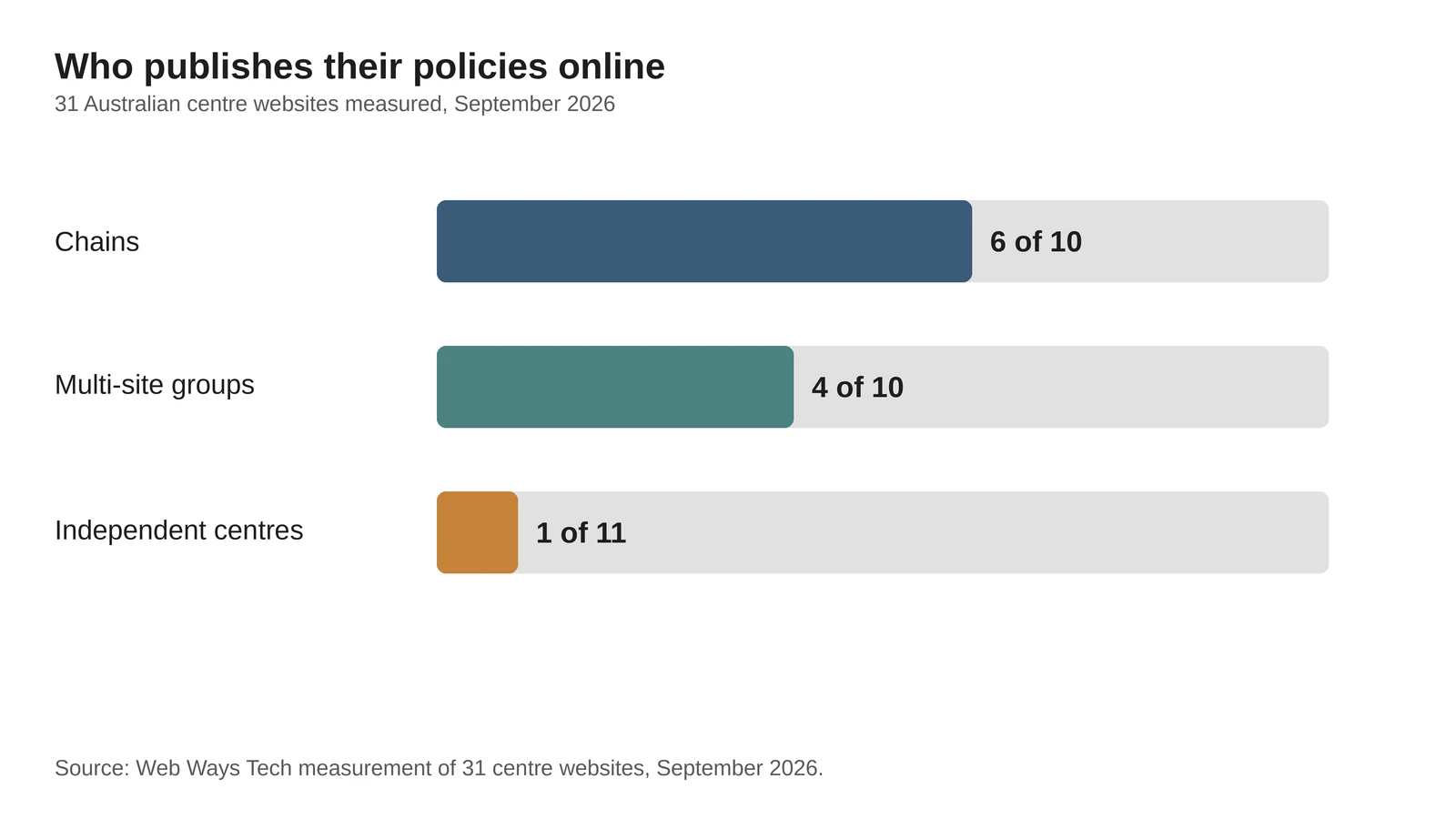
The split is the interesting part:
- chains: 6 of 10
- multi site groups: 4 of 10
- independent single site centres: 1 of 11
For comparison, from the same pass: twelve publish a menu, fourteen publish a philosophy, five publish their own rating, and five publish educator to child ratios.
Independent centres are not being careless. They are doing exactly what the regulation asks and no more, usually because nobody has told them the rest is optional but useful. Meanwhile the chains publish, and a family comparing two services sees documents on one site and a phone number on the other.
Which policies are worth publishing anyway
Not all eighteen. Publishing the lot creates a maintenance job and buries the ones families care about. Five earn their place:
Fees. The most asked question before enrolment, and the one that already carries a 14 day notice obligation. If you publish one document, publish this one with a date on it.
Enrolment and orientation. A family deciding between two centres wants to know what the first fortnight looks like. This is the policy that reads least like a policy and most like an answer.
Illness and infectious diseases. Exclusion periods are the single most common reason a working parent calls. Publishing them saves your staff the call and saves the parent the guess.
Delivery and collection. Who may collect a child, what happens when someone else arrives, what late collection means. Families read this one properly, usually once, at the worst possible moment.
Digital technologies and images. New enough that many services have not updated theirs, and close enough to home that parents ask. Publishing it is a straightforward way to answer the photo question before it is asked.
The remainder stay on request. Your staff code of conduct, governance, acceptance and refusal of authorisations and the rest are real obligations, and nothing is gained by putting them in front of a parent choosing a centre.
How to publish them so they stay current
A policies page goes stale faster than any other page on a centre website. Three habits stop that.
One page per policy, not one PDF pile. A page can be updated in a minute, carries a visible date, and can be linked to directly from an email. A PDF gets replaced by a new PDF with a different file name, and last year’s link dies.
Show the date the version applies from. A line saying it was last updated tells a family nothing about which version governed their situation in March. A line saying it applies from 1 August 2026 does.
Keep the previous version reachable for a while. You do not need an archive going back years. Keeping the superseded version for a few months costs nothing and settles the 14 day question if it ever comes up.
If you are already publishing your rating and your quality areas, the policies sit naturally in the same part of the site. We wrote about that side of it in the seven quality areas and what families see.
Frequently asked questions
Do we have to publish our policies on our website?
No. Regulation 171 requires copies to be available for inspection at the service premises at all times you are educating and caring for children, or otherwise on request. A website is one convenient way to satisfy a request, not a requirement in itself.
Is a PDF enough?
For the regulation, yes. For the family, usually not: a PDF on a phone is harder to read, and it hides the date the version applies from. Either format is compliant.
Does the newsletter count as notifying families of a change?
The regulation says parents must be notified at least 14 days beforehand. It does not prescribe the channel. Email to the enrolment list is the usual method. Keep evidence of what was sent and when.
What if a change cannot wait 14 days?
Regulation 172 covers this. If the notice period would create a risk to the safety, health or wellbeing of a child, make the change and notify parents as soon as practicable afterwards.
Our state has extra requirements. Does the national list still apply?
Yes. Regulation 168 is the national floor, and your regulatory authority can require more on top. Check your state’s early childhood regulator alongside the National Regulations, administered nationally by ACECQA.
The short version
The regulations ask for policies that exist, that staff follow, that anyone can read on request, and that families hear about before they change. That is it. Publishing five of them is a service decision, not a compliance one, and the five worth publishing are the ones families ring to ask about.
Sources: Education and Care Services National Regulations (2011 SI 653), current version 2 January 2026, regulations 168, 170, 171, 172 and 173. Website measurements are our own, 31 Australian centre sites, September 2026. This is general information about what the regulations say, not legal advice.
If your centre website is due for the parts families actually read, see how we build childcare websites.
About the author. Vasilii Aldukhov is the founder and developer at Web Ways Tech, a Sydney web design studio building WordPress websites for Australian childcare centres. Read more on the about page.
This article summarises the Education and Care Services National Regulations as consolidated on 2 January 2026 and our own measurement of 31 centre websites in September 2026. It is general information about what the regulations say, not legal advice. Check your state or territory regulator for any requirements on top of the national floor.