You have a website. You have a Google listing. The phone rings less than it did last year, and nothing at your end changed.
Something at Google’s end did. In August 2026 we ran the search a customer runs, on a phone, in southern Sydney. The electricians in the map pack had no call button between them. The listing above them did, and it was an ad.
This article covers where an Australian electrician, plumber or builder gets found now: the map pack, your own site, and the answers people get from AI tools. Each has moved in the past year, and the fix for each is different.
This is general information, not legal advice. Where a rule affects your licence, read the source and take your own advice.
Key takeaways
- On one Sydney phone search in August 2026, the only map pack listing carrying a call button was the sponsored one. The three organic electricians carried no buttons at all.
- Your Google listing and your website do different jobs. The listing gets you found. The site has to catch the enquiry when the one-tap call is not there.
- Load time is not a technical detail. An older analysis by Portent, reported by Searchlab, put conversion at 3.05 per cent for pages loading in one second against 1.08 per cent at six.
- In NSW, your licensee name, licence number with the correct category, and a business telephone number must appear in all advertising, including your website.
- AI answers are not yet the main event in local search, but they name trades and suburbs literally. Copy that only ever says “tradie” is read as generic.
On our Sydney phone search, the only call button was the ad
On 25 August 2026 we searched electrician near me on a phone in southern Sydney, around Kogarah Bay and Sans Souci. Google returned a block headed Businesses: one sponsored listing, then three organic ones.
The sponsored listing, Braytech Electrical, carried four buttons: Call, Directions, Website and Reviews. The three organic electricians below it, Emco Electrical Services, Elexon Electrical and Liberos Electric, carried none. No call button, no website button, no phone number printed on the card. To ring any of the three, a customer has to tap the listing, wait for the profile to open, and find the number there.
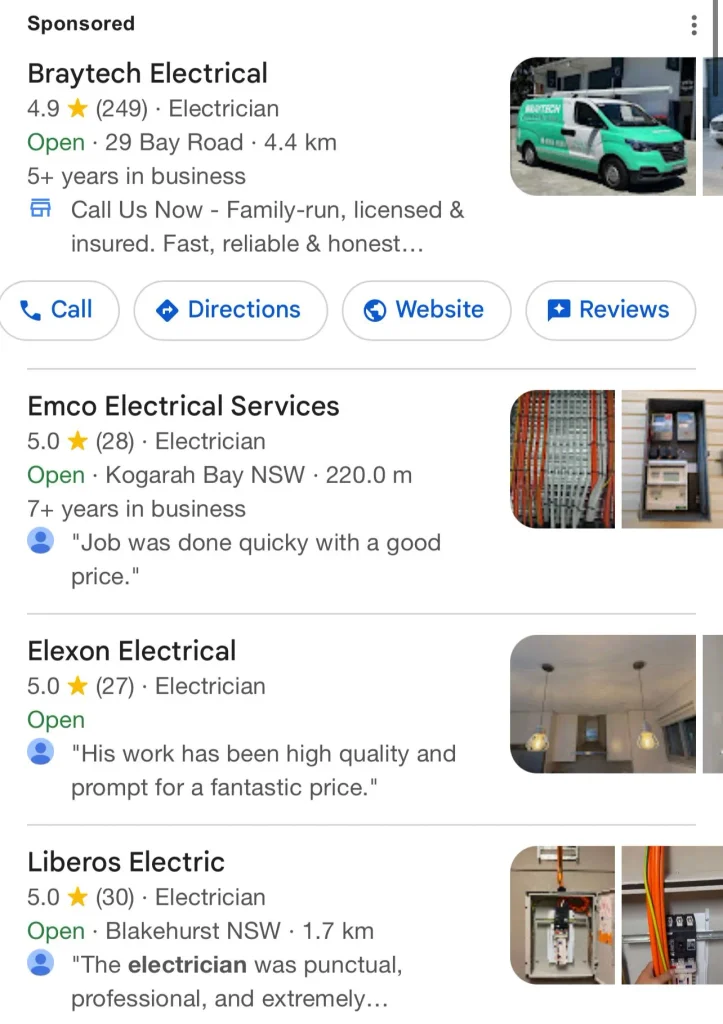
That is one search, in one suburb, at one moment, and we are not going to dress it up as a national study. Two things make it worth your attention anyway.
The first is the contrast with the desktop. We ran the same search on a computer, and there the three organic listings did show Website and Directions buttons, with the phone number in plain text on the card. The gap is on the phone, which is where a customer standing over a tripped switchboard actually searches.
The second is that reporting from the United States describes the same pattern with numbers attached. A study of 3,075 results across 41 niches and 75 postcodes is reported to have found the map pack call button surviving in roughly one search in five. We could not retrieve that report directly, since the page refused our request, so this reaches you as a secondary account and not as something we verified at the source (Programming Insider, retrieved 2026-08-25). Those postcodes are American, so read it as the direction of travel rather than an Australian figure, and check your own trade and suburb on a phone before accepting any of it.
Your Google listing and your website answer different questions
Feeding one does nothing for the other, and most trade businesses feed neither on purpose.
| Your Google listing | Your website | |
|---|---|---|
| What it answers | Who is near me, and are they any good | Are these the right people for my job, and can I trust them in my house |
| What moves it | A steady flow of reviews, replies to those reviews, correct category, hours and service area | A page for each service you want called about, your suburbs in plain text, load speed, a number that dials when tapped |
| What it cannot do | Explain a complicated job, show your licence details in full, or price anything | Put you in the map pack when somebody searches near me |
The listing side is unglamorous. An established stream of reviews over 90 days reads better than 50 collected in one month followed by silence, replies feed a review engagement component in local ranking, and posts are worth doing for click-through in the local panel rather than for pack position (Digital Applied, retrieved 2026-08-25). That source is an agency guide rather than Google documentation, so treat the mechanism as a working model and watch your own numbers.
What the table cannot show is the handover. The customer found you through the listing, and from the moment they land on your site with a burst pipe in mind, everything is yours to control. We cover what the site needs to carry on our page about websites for Australian trade businesses.
A slow site on a phone is an invisible site
Your customer is not sitting at a desk. They are on mobile data, one bar down, standing in a hallway with water coming through the ceiling. Most contractor searches happen on a phone, and vendor benchmarks put that share above three quarters (PipelineOn, retrieved 2026-08-25).
Under those conditions load time stops being a technical detail and becomes the enquiry itself. An analysis by Portent, reported by Searchlab, found conversion falling from 3.05 per cent on pages loading in one second to 1.08 per cent at six seconds (Searchlab, citing Portent, retrieved 2026-08-25). That study predates the current mobile mix, so take the shape of the curve rather than the decimal places. Older Google mobile speed research put abandonment at 53 per cent once a page passes three seconds, and it is old enough now to treat as a rule of thumb rather than a current measurement.
On trade websites the usual culprit is the thing you are proudest of. Photos of finished switchboards, bathroom rough-ins and decks, uploaded straight off a phone at full size, four megabytes each, twenty of them on the gallery page. They look fine on your laptop on wifi. On a customer’s phone on mobile data they are the reason the page never finishes.
Name the trade, name the suburb
Ask ChatGPT about tradie websites in Australia and it does not search for the phrase you typed. It writes its own searches first. On 24 August 2026 we read those searches out of the model’s own request data through the browser network tab, and there were three:
tradie website design Australia trades websites electricians plumbers builders 2026Sydney tradie website design trades web design electrician plumber builderAustralia tradie website builder SEO Google Business Profile trades
Electricians, plumbers and builders are spelled out in two of the three, rather than the collective “tradie”. One names a city. And the third treats the website, the builder platform, SEO and the Google Business Profile as a single subject rather than four separate ones.
That is a useful mirror, because it is close to how a customer types and how ordinary Google reads a page. We ran the count on our own hub page before writing this and it was not flattering: “tradie” forty-six times, “electrician” twice, “plumber” twice. A page like that describes a category rather than a business. Put the trade and the suburb where they carry weight: the page title, the heading, the first sentence, and the service pages themselves.
Do not over-rotate on the AI part. One compilation puts AI Overviews on roughly 7 per cent of local searches, well short of the takeover the headlines suggest, though the figure is not broken out for Australia and prevalence moves quickly (The Valley Marketing Group, citing research compiled by Affinco, retrieved 2026-08-25). Apply the naming lesson because it helps in ordinary search today, with the AI surfaces as a bonus later.
The licence details NSW law requires on your website
This one is not an opinion, a ranking factor or a growth tactic. It is the law, and it is checkable on your own site in about thirty seconds.
NSW Fair Trading requires a building trade advertisement to carry three things (NSW Government, retrieved 2026-08-25):
- The licensee’s name, being the individual, company or business name registered to the licensee.
- The licence number, with the correct category of work.
- A business telephone number.
Those details “must be shown in all advertising”, and advertising includes the internet alongside print, television and radio. The same page states that the Act prohibits a company or individual from advertising for any residential building work over $5,000, or specialist work of any value covering electrical wiring, plumbing, draining, gasfitting, air conditioning and refrigeration, without holding a current contractor licence.
NSW is not Australia. Every state and territory runs its own regulator with its own wording, so confirm the requirement where you actually work. It is worth doing beyond compliance in any case, because a licence number printed with its category is exactly the kind of specific, verifiable detail that separates a real business from a template site, for a customer and for a search engine reading the page.
Every one of the twenty-two pages ChatGPT cited when we asked it about tradie websites in Australia is published by a company selling that service. The licence requirement did not come up in any of the guidance we read among them.
Check this yourself before you spend anything
Run these on your own phone, in order.
- Search your trade and suburb. Do you appear in the map pack at all? If not, the problem is the listing, not the website.
- Count the taps to your number. From the search result to a ringing phone. If it is more than two, your website has to close that gap.
- Check your phone number is a link. Tap it on your own site. If nothing happens, it is text or an image, and every mobile visitor is copying it by hand.
- Time your slowest page. Usually the gallery. If it is still loading after five seconds on mobile data, compress the photos before anything else.
- Read your homepage heading aloud. Does it say electrician, plumber, carpenter or builder, and does it name your area? Or does it say “quality workmanship”?
- Find your licence number. It should be visible on the page itself, not only in the footer, with the category of work beside it.
- Open your Google listing. Are the hours right, is the service area sane, and has anyone replied to the last five reviews?
- Check the last review date. If the newest one is from last winter, that is the cheapest fix on this list.
Anything on that list you can do yourself in an afternoon is worth doing yourself. If the site is the bottleneck and you would rather hand it over, tell us what is not working and we will tell you what we would change.
Frequently asked questions
How do I get my trade business into the Google map pack?
Three things carry most of the weight: a complete Google Business Profile with the right primary category, proximity to the searcher, which you cannot change but which your stated service area interacts with, and reviews arriving steadily rather than in bursts. If you do not appear at all for your trade and suburb, start with the profile rather than the website, because no amount of site work will place you in a block your listing is not eligible for. If you appear but the enquiries do not follow, the problem has moved to your site.
Do I still need a website if I have a Google Business Profile?
Yes, and more than before. The profile is what gets you found. The website is what catches the enquiry once the customer has to tap through to reach you, and it is where the details that win the job live: your services, your licence number, your recent work and your price range. The two answer different questions, which is why filling in one and neglecting the other leaves calls on the table.
What has to be on a tradie website by law in Australia?
In NSW, a building trade advertisement must show the licensee’s name, the licence number with the correct category of work, and a business telephone number, and that requirement covers the internet as well as print and broadcast. Advertising residential building work over $5,000, or specialist work of any value, without a current contractor licence is prohibited. Other states and territories set their own rules through their own regulators, so confirm the wording that applies where you work.
Does my trade website need to be built on WordPress?
Not necessarily, and the honest answer depends on whether you want to own the thing outright or rent it. We set out the trade-off, including when a hosted builder is genuinely the cheaper call, on our page about a trade website you own outright.
Where to start
Run the check above first, because most of it costs nothing and it tells you which part is actually broken. Compress the photos, make the phone number a link, print the licence number with its category, reply to the reviews sitting there unanswered, and say electrician, plumber or builder where your page currently says tradie.
If the check tells you the site itself is the problem, that is the part we do. Talk to us about a trade website built to catch the call when the map pack does not hand it over.
About the author. Vasilii Aldukhov is the founder and developer at Web Ways Tech, a Sydney web design studio building WordPress websites for Australian trade businesses. The map pack observation and the ChatGPT search capture in this article are his own, recorded in August 2026. Read more on the about page.