
A parent touring your centre will ask how many educators are in the room. The legal answer depends on the child’s age and your state, and it fits in one table. Yet when we checked 90 centre websites, not one showed its ratios on the enrolment or fees page.
This guide gives you the legal minimums first, with the regulation behind each number. Then it shows what other centres publish, and a ratios block you can put on your own enrolment page.
In brief
- The national minimums for centre-based care are 1:4 up to 24 months and 1:5 from 24 to 36 months. From 36 months to preschool age it is 1:11, and school-age children are 1:15.
- Victoria, NSW, Tasmania, WA and the ACT each replace at least one of those bands with their own figure.
- On 28 October 2026 ACECQA still says ratios are calculated across the whole service, not room by room. Legislation on supervision is planned for 2027.
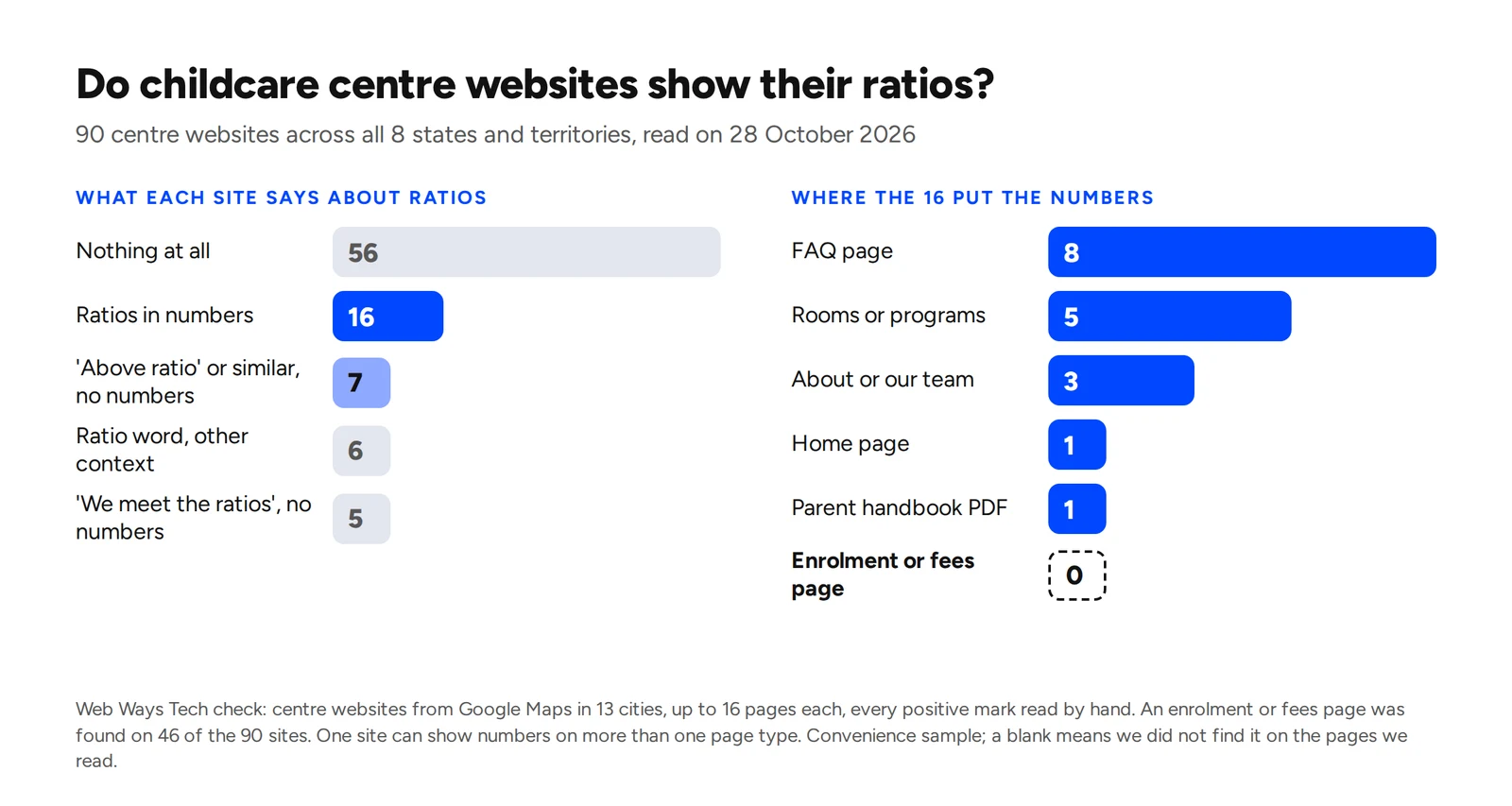
- Of 90 centre websites we crawled, 16 publish their ratios in numbers. None does it on the enrolment or fees page.
- The law does not require you to publish ratios online. A centre that does answers a question most competitors leave open.
Childcare ratios by age and state
An educator to child ratio is the legal minimum number of educators for a group of children of a given age. The Education and Care Services National Regulations set one educator to child ratio for each age band in centre-based care. Regulation 123 holds the national figures. Five jurisdictions replace a band with their own rule.
| Jurisdiction | Birth to 24 months | Over 24 and under 36 months | 36 months to preschool age | Over preschool age |
|---|---|---|---|---|
| ACT | 1:4, reg 123(1)(a) | 1:5, reg 123(1)(b) | 1:11, reg 123(1)(c) | 1:11, reg 260 |
| NSW | 1:4, reg 123(1)(a) | 1:5, reg 123(1)(b) | 1:10, reg 271 | 1:15, reg 123(1)(d) |
| NT | 1:4, reg 123(1)(a) | 1:5, reg 123(1)(b) | 1:11, reg 123(1)(c) | 1:15, reg 123(1)(d) |
| QLD | 1:4, reg 123(1)(a) | 1:5, reg 123(1)(b) | 1:11, reg 123(1)(c) | 1:15, reg 123(1)(d) |
| SA | 1:4, reg 123(1)(a) | 1:5, reg 123(1)(b) | 1:11, reg 123(1)(c) | 1:15, reg 123(1)(d) |
| TAS | 1:4, reg 123(1)(a) | 1:5, reg 123(1)(b) | 1:10, or 2:25 in a preschool program, reg 342 | 1:15, reg 123(1)(d) |
| VIC | 1:4, reg 123(1)(a) | 1:4, reg 357 | 1:11, reg 123(1)(c) | 1:15, reg 123(1)(d) |
| WA | 1:4, reg 123(1)(a) | 1:5, reg 123(1)(b) | 1:10, WA Local Regulations r 27 | step table, reg 369 |
These are minimums. The provider must meet them all day, every day. The ACECQA educator to child ratios page has the same figures and a calculator. They sit under the National Quality Framework (NQF). Staffing is Quality Area 4 of its National Quality Standard (NQS).
Qualification requirements sit on top of the numbers. At least 50% of the educators counted in ratio for children preschool age or under must hold, or be working towards, an approved diploma. The rest must hold, or be working towards, at least a certificate III (reg 126).
Ratio requirements by state, and what changed in WA in 2026
Most of the table repeats the national figure. The exceptions are few, and each one changes a roster.
Victoria keeps 1:4 for children over 24 months and under 36 months (reg 357). A Victorian toddler room needs one more educator per 20 children than the same room in NSW.
NSW and Tasmania use 1:10 for children from 36 months to preschool age (regs 271 and 342). Tasmania adds a separate figure of 2 educators to 25 children in a preschool program.
WA changed how its rules are written. From 1 May 2026 its own 2012 regulations were repealed, and the national text now applies with WA modifications. The WA Local Regulations 2026 keep 1:10 for children from 36 months to preschool age.
WA also kept a rule no other state has. A child can be treated as up to 6 months older or younger for ratio purposes (reg 123(7), as modified locally). The provider must judge it developmentally appropriate, record the decision and get a parent’s signature.
NT, Queensland and SA follow the national figures for every band. Queensland adds rules for short breaks, covered below, and one larger exception. If a service’s approval carries a rest period condition, it may run lower ratios during rest time. That is capped at 2 hours a day (regs 299A to 299E). School-age differences in the ACT and WA are covered in the family day care and OSHC section below.
Who counts toward the educator to child ratio
Working directly with children means being physically present with the children and directly engaged in their education and care (reg 13). Only an educator doing that counts toward the ratio (reg 122).
The NSW Early Learning Commission spells out what that means on a normal day:
- An educator on a planned break cannot be counted, even if they stay on the premises.
- A staff member doing administration or programming cannot be counted.
- In NSW, short unplanned breaks, for example for personal hygiene, do not need back-fill.
- Educators under 18 can be counted. They must not work alone, and an educator aged 18 or over must supervise them (reg 120).
Four states soften the break rule. SA (reg 325A), Tasmania (reg 342A) and WA (reg 123(2A), as modified locally) use the same limit. An educator can step away for up to 30 minutes in a day and still count. The educator must remain available, or the program must keep children safe. Queensland allows shorter breaks: 2 rest pauses of up to 10 minutes a day (reg 299F) and absences of up to 5 minutes (reg 299H).
Parents often ask about students and volunteers. Under the National Law, an educator is anyone who gives education and care as part of the service. Pay does not come into it. So a student or volunteer can count, but only while working directly with children and only if they meet the qualification rules. The NSW regulator says ‘Volunteers can be included as educators when counting ratios.’ Check with your regulator before rostering a student into ratio.
Every centre-based service must keep a record of the educators working directly with children and their hours (reg 151). A staff roster or timesheet can serve as that record. It is the main document behind your ratio compliance, and keeping that documentation current is part of the duty.
Across the whole service, not per room, for now
On 28 October 2026 the ACECQA page still says, word for word: ‘Ratios are calculated across the whole service (not by individual rooms).’
The same page explains mixed ages. One educator can count for two age groups, as long as each group’s ratio is met and the children are well supervised. The ratio for babies does not have to apply to every older child.
Here is how that works in a family grouping at 7am. Say 3 babies under 24 months and 8 three-year-olds share one room. The babies need one educator at 1:4. The 8 older children need one educator at 1:11, or at 1:10 in NSW. Two educators cover the room. NSW guidance puts it simply: meet the ratio for the youngest child first.
The ACECQA ratio calculator does this sum for a whole service. ACECQA describes it as a guide only.
The rule may change. In February 2026 Education Ministers decided to remove the ‘across the service’ provision, according to the federal Education Minister’s update and The Sector. It is a decision, not yet a change to the law. In July 2026 ministers agreed a second tranche of reforms covering supervision. Legislation is planned ‘as soon as possible in 2027’, according to the Department of Education.
Until the law changes, you may count across the service. It does not replace good supervision in each room.
Family day care and OSHC ratios
Family day care. In a family day care setting, one educator may care for no more than 7 children at any one time. No more than 4 of them can be preschool age or under (reg 124). The educator’s own children count toward the 7 if they are under 13 and no other adult is caring for them.
Outside school hours care (OSHC). School-age children in centre-based care need 1:15 in NSW, NT, Queensland, SA, Tasmania and Victoria. The ACT uses 1:11 (reg 260).
WA uses a step table instead of a single ratio (reg 369). With no preschool child in the session, one educator covers the first 10 children. Two cover from 11 to 26, and each further educator covers 13 more.
What a ratio does not tell a parent
The government’s parent site, Starting Blocks, says ratio requirements ‘ensure adequate supervision for safety, welfare and wellbeing of children’. Even so, a centre can meet every number in the table and still fail a child. Adequate supervision is a separate duty under section 165 of the National Law, and it applies at all times.
The NSW regulator publishes its breach counts. From April to June 2026 it recorded 279 breaches of section 165 for inadequate supervision. It also recorded 307 breaches of reg 151, the educator record described above. And 351 breaches of section 172 covered failures to display prescribed information, such as approvals and ratings.
What NSW does not publish is a count of ratio breaches as such, so nobody can honestly quote one. The numbers it does publish point the same way. Supervision and records are where services fall down, and a ratio on paper does not show either.
What 90 centre websites show about their ratios
Method and sample size. On 28 October 2026 we crawled 90 Australian long day care websites across all 8 jurisdictions. We took the top Google Maps results for ‘childcare centre’ in 13 cities and read up to 16 pages per site, 726 pages in total. Every positive finding was checked by hand against the quoted text.
- 16 of 90 (18%) publish their ratios in numbers.
- None of them shows those numbers on an enrolment or fees page. We found such a page on 46 sites.
- 1 claims better-than-minimum ratios in numbers.
- 7 make a vague claim with no numbers, such as ‘meet or exceed national requirements’.
- 56 (62%) say nothing about ratios at all.
Independent single-centre sites made up 41 of the sample, and 8 of them publish numbers.
Where numbers do appear, they sit in an FAQ on 8 sites and on room or program pages on 5. Three put them on an about page, one on the home page and one in a parent handbook PDF.
The best examples state ratios as a fact about each room. Sylvie’s Early Learning Centre in Townsville puts them on its home page: ‘Nursery 6 weeks – 2 years · 1 educator to 4 children’. Rose Park Community Childcare in Adelaide adds group size and staffing: ‘a maximum of 20 children with a ratio of 1 educator to 4 children. There are generally 5 educators in this environment on any day.’
Only Geelong Children’s Centre claims better than the minimum in numbers. Its team page says: ‘We work above ratio in all age groups, each of our under 3’s learning spaces with a ratio of 1:3 and our over 3’s learning programs have a ratio of 1:6’.
Treat these numbers as a snapshot, not a census. The sample is the top of Google Maps, with one site per chain. We crawled up to 16 pages per site, so a figure in an image or an enrolment pack would not show.
Why the enrolment page is where ratios belong
Families ask. On 7 September 2026 a parent in an Adelaide community group wrote: ‘Anyone know of any childcare centres that generally run above ratio. Meaning more educators in the room than required by ratio regulations?’ She asked a community group, not a centre website. Even a large provider tells families to raise it: Guardian’s tour FAQ says ‘Ask about staff ratios.’
The law does not make you answer online. Section 172 and reg 173 list what you must display at the entrance: approvals, supervisors, ratings, waivers, hours, contacts and some health notices. Educator to child ratios are not on it, and the duty applies to the premises, not to your website.
So the enrolment page is free space. It is where a family compares centres before booking a tour, and in our crawl no centre used it for ratios. Transparency is also one of the 3 themes ministers named for the next reform tranche, so the sector is moving this way anyway.
A ratios block you can put on your enrolment page
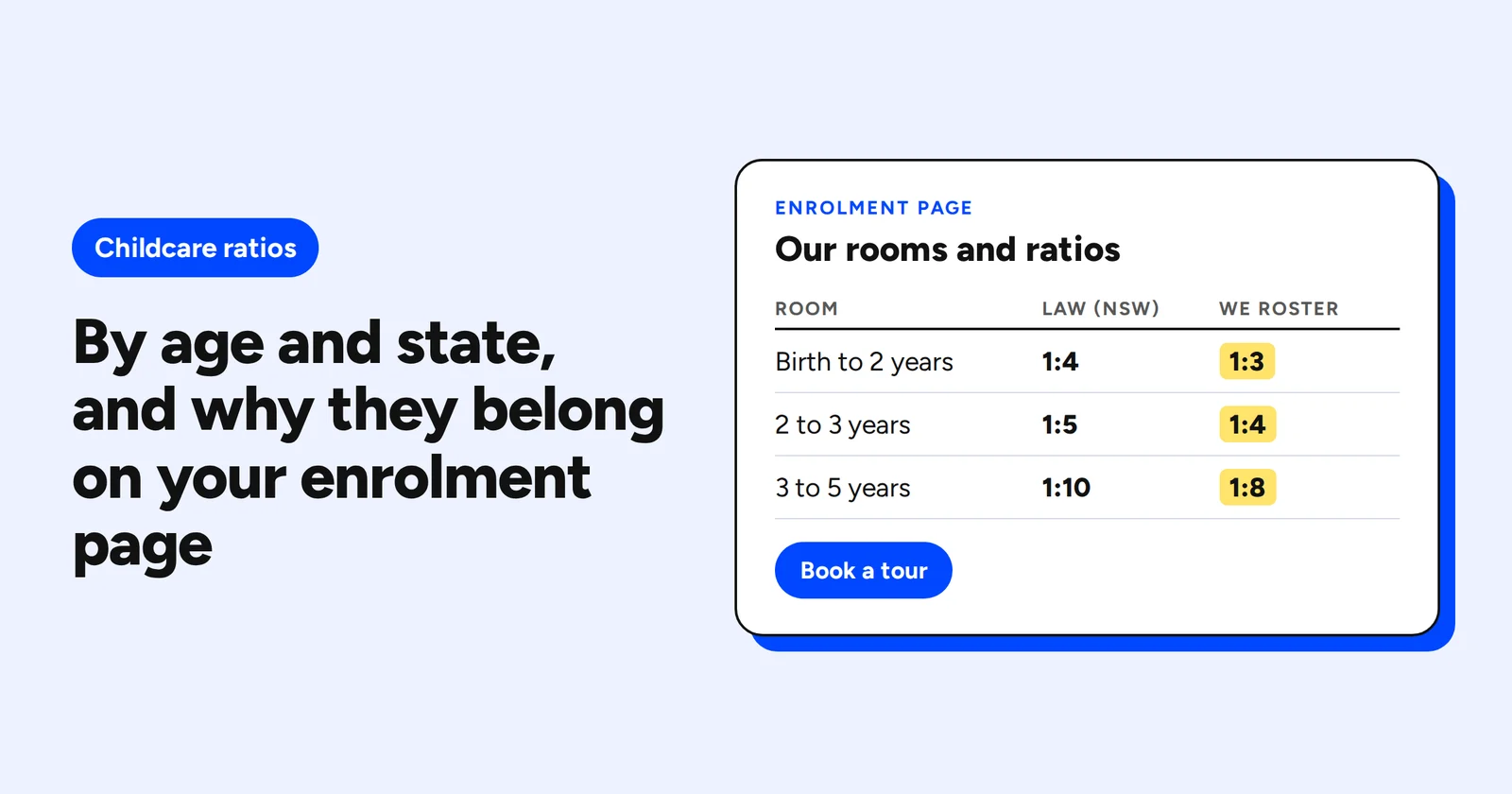
Keep it factual and keep it per room. A block like this fits under your fees or enrolment details:
Our rooms and ratios (checked 28 October 2026)
- Nursery, 6 weeks to 24 months. Legal minimum 1:4. We usually roster 1:3: up to 12 children with 4 educators.
- Toddlers, 24 to 36 months. Legal minimum 1:5. We usually roster 1:4: up to 16 children with 4 educators.
- Preschool, 3 to 5 years. Legal minimum 1:10 in NSW. We usually roster 1:8: up to 24 children with 3 educators.
- Breaks. A floating educator covers lunch breaks, so rooms stay in ratio.
- Source. National Regulations, regs 123 and 271, via ACECQA. Ask us for this week’s roster on your tour.
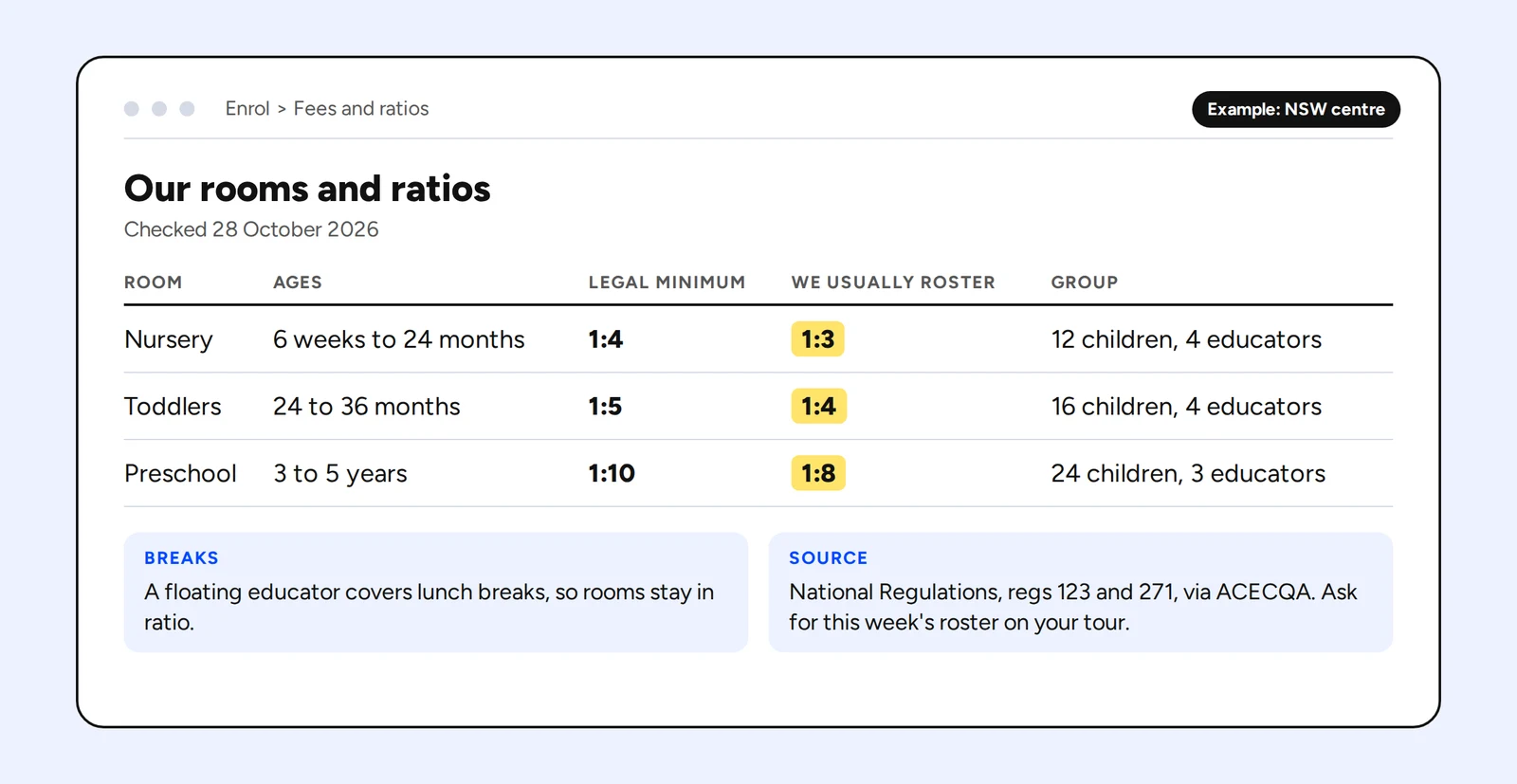
This example is for a NSW centre. Replace the sample figures with your own state minimums and roster. Keep the block next to fees and funding details, not inside them. Four fields carry the weight: age band, legal minimum, what you usually roster and who covers breaks. The date tells families the figures are current.
Compare that with a real fees page. Hamilton Early Learning Centre in Newcastle explains its fee for children from 6 weeks to 2 years by ‘higher educator to child ratios’, with no number anywhere.
- Before: ‘higher educator to child ratios’
- After: ‘Children under 2 are in a room at 1:4, one educator for every four children. That room needs more educators per child, so the daily fee is higher.’
Same facts. The second version tells the family what they are paying for.
What not to claim about your ratios
A ratio claim on your website is a claim about your service. The Australian Consumer Law, section 29(1)(b), prohibits a ‘false or misleading representation that services are of a particular standard, quality, value or grade’. Section 18 covers misleading conduct more broadly.
- Do state the legal minimum and what you usually roster, with a date.
- Do not write ‘above ratio’ unless it holds every hour you are open, including breaks and late afternoons.
- Do not borrow ‘meet or exceed’ wording without a number behind it.
Geelong Children’s Centre, quoted above, shows the safe way to say it: specific numbers per age group that families can check on a tour.
Frequently asked questions
What is the ratio for 2 to 3 year olds in NSW?
1:5. NSW uses the national ratio for children over 24 months and under 36 months. Its own 1:10 rule applies from 36 months.
Are childcare ratios different in Victoria?
Yes, for one band. Victoria requires 1:4 for children over 24 months and under 36 months, where the rest of Australia uses 1:5.
Do students on placement count in ratio?
They can, in limited cases. A student or volunteer counts only while working directly with children. They must also meet the qualification rules, for example by actively working towards a certificate III. The NSW regulator confirms volunteers can be counted. Ask your regulator before you roster a student into ratio.
Do educators on lunch break count?
No. An educator on a planned break is not working directly with children, even on the premises. SA, Tasmania and WA allow up to 30 minutes away in total a day, and Queensland allows 2 rest pauses of up to 10 minutes.
Do centres have to publish their ratios?
No. The display rules in section 172 and reg 173 do not list ratios, and they apply to the premises. Publishing them online is voluntary.
Putting your ratios on the page
If your enrolment page cannot show room ratios today, that is a website problem. It is also the kind we fix when we build childcare websites. We write the pages.
A Website Build is $2,000, with no GST added. Hosting is billed to you directly by the host, usually about $50 a year with the domain name. You own the domain, the hosting account and the files, all in your own name. The packages page lists what each build includes. For related reading, see what the 7 Quality Areas mean for your website and which policies families must be able to see.
If your current site hides the answers families ask for, talk to us about fixing your current website. You can read more about us first, or contact us with your current enrolment page.
This article is general information, not legal advice. The rules change, and some differ by state. Check with your regulator before you change your roster or your website. Fact-checked against the regulation texts on 29 October 2026.