Your website lists your supports, maybe a rate, maybe a cancellation policy. A participant in the National Disability Insurance Scheme (NDIS) reads those lines before they see your service agreement. This post sorts each kind of term into two piles: what the public page can say, and what stays in the signed agreement. Every row rests on a document we read on 3 November 2026.
In brief
- A service agreement is an agreement between a participant and a provider about the participant’s NDIS supports. It is mandatory for specialist disability accommodation (SDA) and strongly encouraged for other supports, particularly supported independent living (SIL).
- In the documents we read, nothing requires a provider to publish prices, cancellation terms or a Terms page on its website. What you do publish has to match what you sign.
- The cancellation notice figures of 2 clear business days and 7 days appear in the 2025-26 pricing arrangements. They do not appear in the 2026-27 Pricing Schedule.
- Of 219 provider websites we read in NSW, 46 have a Terms page. Of those, 7 still hold template text. Only 5 sites name a cancellation period in figures.
What an NDIS service agreement is, and where the mandate stops
The National Disability Insurance Agency (NDIA) says a service agreement ‘describes what you and your provider have agreed to about your NDIS supports’.
Who needs one? The NDIA’s news item of 13 October 2026 is direct. ‘Service agreements are mandatory for Specialist Disability Accommodation (SDA).’ They are ‘strongly encouraged as best practice for other supports, particularly Supported Independent Living (SIL).’ Its page for participants says ‘You don’t need one for other supports’. It recommends one ‘when you start working with a new provider or if your needs change’.
So the mandate stops at SDA. For everything else a written service agreement is recommended, not required.
The NDIS Practice Standards speak to form, not to whether you must write one. Where an agreement is in writing, ‘each participant receives a copy of their agreement signed by the participant and the provider’. That wording is from the November 2021 Version 4 file we read, so check it against the current compilation. Our NDIS audit checklist goes through the Practice Standards section by section.
The NDIA lists what a good agreement covers. That includes who it is for, the participant’s goals and NDIS plan, the supports and their costs, dates and reviews, rights and responsibilities, and what to do when you disagree. One limit is worth knowing. ‘The NDIA is not party to the agreement and does not record or enforce service agreements.’
What the new NDIS service agreement template and checklist of 13 October 2026 change
The same day, the NDIA released ‘a new service agreement template, checklist, guidance and Easy Read resources’, developed with the NDIS Quality and Safeguards Commission. Using the template is optional. ‘If participants and providers choose to use the template, they must tailor it to their needs.’
We read the template itself. We did not read the checklist or the Easy Read files, so nothing here describes them.
Two clauses matter for a public page, and a third comes up in the cancellation section below.
On ending, either party gives written notice, with a timeframe the template leaves blank, followed by a plain line: ‘You will not be charged an exit fee’ to end the agreement. On changing, ‘If we propose a price change and you do not agree, you may end the Agreement straight away.’
For plan-managed and NDIA-managed participants, the template says ‘terms must not exceed the NDIS Pricing Schedule’. Its own disclaimer tells a provider to obtain, and rely on, appropriate independent legal advice before using it. Treat it as a starting point to adapt, not a document to paste in. It keeps the complaints and feedback section and a dispute resolution process inside the signed document, and lists among participant rights that they ‘have choice and control over the supports you access’.
What to publish on your website and what stays in the agreement
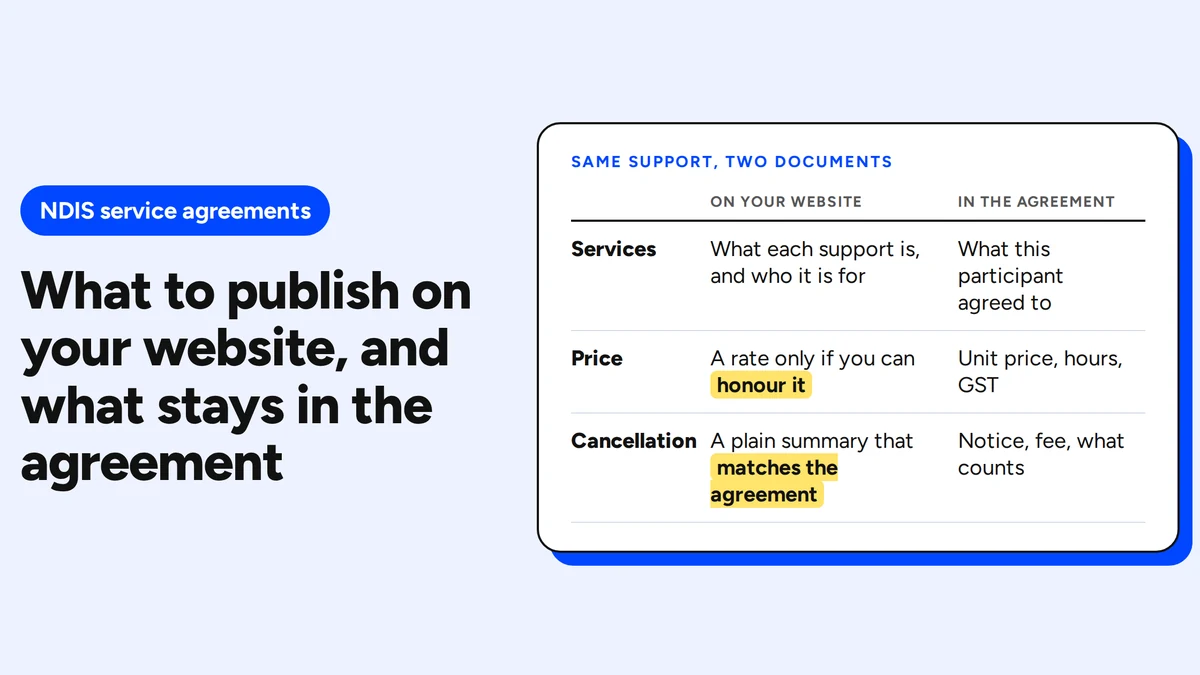
The table is our reading of how to line a public page up with the documents. It is a guide, not a rule.
The sources do not tell you to publish any of it. Neither the template nor the NDIA pages say anything about publishing on a provider’s own website. The Practice Standards ask that supports and ‘any associated costs’ are ‘clearly defined and documented’. They also ask that this is ‘communicated to each participant’ in terms they understand. They name no channel.
| Kind of term | On your website | Stays in the signed agreement | Source |
|---|---|---|---|
| Services and what is included | A plain description of each support and who it is for | The supports this participant has agreed to, and how and when they are delivered | NDIA, How to make a service agreement; Practice Standards, Access to Supports |
| Prices and extra charges | A rate only if you can honour it in the agreement. For NDIA-managed and plan-managed participants it cannot exceed the maximum price | Support item, quantity or hours, unit price, total cost, GST component, and extra charges such as travel | NDIA, Pricing arrangements; NDIA, How to make a service agreement; template, Attachment A |
| Cancellation | A plain summary ending with ‘details are in your service agreement’. A figure only if the agreement carries the same one and you name its source | Notice period, fee, what counts as a cancellation, and what happens if the provider cancels | NDIA, How to make a service agreement; template, Cancellations; PAPL 2025-26 |
| Changing and ending | A short note that either side can ask for a review or end the agreement | Notice, exit terms and how a price change is handled | Template, Ending and Changing |
| Complaints | Who to contact, and avenues outside your business | A clear complaints process | Practice Standards; NDIA, How to make a service agreement |
| Privacy and consent | What you collect and why | The participant’s own consent and records | Practice Standards, privacy indicator |
| Names, contacts, goals, dates, signatures | Nothing | All of it | NDIA, How to make a service agreement |
Our earlier post on what a provider writes about participants covers the privacy and consent wording, so we do not repeat it here.
The sources mention a provider’s website and a price in only one place. The Commission’s page on price differentiation gives an example. Providers ‘cannot advertise on their website a sale price of the shower chair, but say the sale price isn’t for NDIS participants’. That rule is about goods, which the next section covers.
A price on your website is a promise the agreement has to keep
Start with the limit. The NDIA’s Pricing arrangements page, current as of 24 September 2026, says ‘The maximum prices in the schedules only apply to NDIA-managed and plan-managed participants’. It adds that ‘NDIS providers can’t charge more than the maximum price limits’. In the Pricing Schedule 2026-27, ‘Any maximum amount specified in this document already includes any Goods and Services Tax (GST).’ The Schedule applies its maximums where the NDIA or a registered plan management provider manages the funding.
The limit has an edge. The 2025-26 pricing arrangements say ‘The NDIA does not set the prices that providers charge participants’. They add that providers ‘should not indicate in any way’ that their prices are set by the NDIA. A public rate card should not read as if the NDIA set it. Our post on the 2026-27 NDIS price guide covers the line items themselves.
The goods rule is narrower. The Commission says its price rule ‘is only about goods, not services’, and that ‘further changes might be made about other supports’. The Code of Conduct Rules bar a higher price for goods to a participant than to anyone else, without a reasonable justification. For services, the 2025-26 arrangements are softer. Providers ‘should not charge NDIS participants more for a support than they would charge anyone else’. A different price should come with its reasons explained to the participant.
Here is our practical conclusion, and it is ours, not a quotation. A published rate is the first number a participant sees. If the agreement later shows another, they hold two documents that disagree. Keep the public figure in step with the agreement, or publish the basis and leave the number to the agreement.
Cancellation terms: what your website can say and what the agreement must hold
The Pricing Schedule 2026-27 prices cancellation. It has Cancellation lines, for example an occupational therapist cancellation hour at $193.99 on the national rate, and Provider Travel lines. It does not say when a cancellation fee may be claimed. The words ‘service agreement’, ‘clear business days’, ‘short notice’ and ‘notice’ do not appear in it.
The conditions sit in an older document. The 2025-26 pricing arrangements, version 1.1, were valid from 24 November 2025. A provider ‘can claim up to 100% of the agreed fee’, subject to the arrangements and ‘the terms of the service agreement with the participant’. The document sets two periods, where DSW means disability support worker:
- 2 clear business days. It ‘typically applies to non-DSW supports where a participant has provided less than two (2) clear business days’ notice’.
- 7 days. It ‘typically applies to DSW supports where a participant has provided less than seven (7) days’ notice’.
- A condition: ‘The provider was not able to find alternative billable work for the relevant worker.’
Providers may waive the fee. The document also says ‘Providers should document the terms of short notice cancellations polices in participant service agreements’ (the spelling is the source’s). For a participant whose plan the NDIA manages, a provider ‘Must declare relevant prices and conditions to participants before delivering a service’. That includes ‘any notice periods or cancellation terms’.
Now the catch. That document is the 2025-26 one. The NDIA’s page still lists it under 2025-26. It also says ‘We will shortly publish updated pricing and claiming guidance documents.’ Neither the 2025-26 file nor the 2026-27 Schedule says whether the cancellation rule carries into 2026-27. So a notice period on your site is a claim about a rule you can trace only to last year’s document.
The NDIA template gives a safer anchor. Its cancellation clause is short. ‘[Insert provider] will only charge for a short notice cancellation or no-show when there has been an actual loss.’ It adds that the provider will not charge a fee ‘where it would be unfair, in line with Australian Consumer Law’. The notice period, the fee and examples of what counts are blanks for you to fill in.
Here is public wording we would be comfortable with. It is a suggestion, not a rule.
If you need to cancel a support, please tell us as early as you can. Our cancellation terms, including any fee and the notice we ask for, are set out in your service agreement.
It states no number, so nothing on the page can drift from the agreement.
What 219 NDIS provider websites in NSW publish about their terms
Between the page and the agreement sits what providers actually do. On 3 November 2026 we read the home page and up to 10 internal pages of NDIS provider websites in NSW. The list of 229 domains came from Google Maps, collected in September from 12 search points. Of those, 219 opened. The other 10 did not: 3 returned server errors, 5 did not resolve, 1 had a certificate error and 1 answered with a 403, which we did not work around. We read the pages with an honest user agent and set the classes by hand from quotations.
Across the 219:
- 46 (21%) have a page with ‘terms’ or ‘condition’ in its address.
- 7 of those 46 pages (15%) still hold template text, such as ‘[insert jurisdiction]’, ‘Lorem ipsum’ or ‘{{itemName}}’. One of the 7 also uses online-shop language about cancelling orders.
- 5 name a cancellation period in figures: 24 hours on one site, 48 hours on two, 2 business days on two.
- 4 publish their own hourly rates for NDIS supports.
- At least 5 hand their prices or cancellation terms to ‘your service agreement’ in a single phrase.
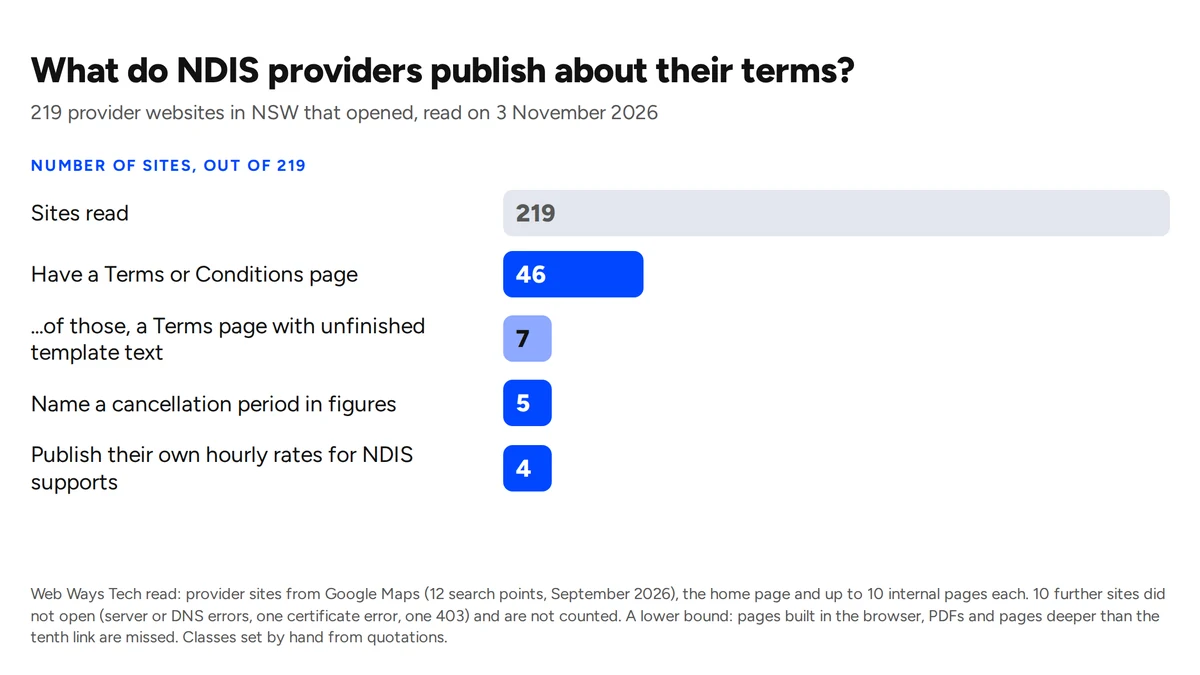
Here is how the 219 split. 173 of the 219 sites had no page with ‘terms’ or ‘condition’ in its address among the pages we read. Of the 46 that did, 7 hold a page that was never finished. The other 39 hold no placeholder text, though we did not judge what they say. These three anonymised fragments come from the 7 unfinished pages.
‘…shall be governed by and construed in accordance with the laws of [insert jurisdiction], without regard to its conflict of law principles.’
‘Payment Methods: We accept [list payment methods, e.g., credit cards, PayPal, etc.]. Order Cancellation: We reserve the right to cancel orders for any reason, including suspected fraud or product unavailability.’
A Terms page where the token ‘{{itemName}}’ is still in the text.
Read the figures as a lower bound. Sites that build their pages in the browser, pages deeper than the tenth link and PDFs are not counted. The sample is NSW and the list is from September 2026, so we do not extend it to Australia. Our placeholder search used a limited list of words, so other kinds of borrowed text went uncounted. Three sites share one sentence, ‘We reserve the right, at Our sole discretion, to modify or replace these Terms…’, which suggests a common template. That is an observation, not a metric.
Some providers do publish full terms, including pricing, travel and cancellations. We are not saying nobody does. Most of the sites we read do not, and sending the details to the service agreement is a normal choice. The risk sits in what stays on the site meanwhile. A borrowed page can promise things you never agreed to, such as cancelling orders for product unavailability.
Unfair contract terms: why hiding terms behind links does not help
A website is not a contract. In our reading, though, terms you place on it tend to reappear in the standard form agreement a participant signs. That is where the consumer law test applies.
Treasury’s Final Report on the unfair contract terms protections (May 2026, published 29 June 2026) states the test. A term in a standard form consumer contract is unfair if all 3 conditions are met:
- it causes a significant imbalance in the parties’ rights and obligations
- it is not reasonably necessary to protect the legitimate interests of the party who benefits from the term
- it would cause detriment, financial or otherwise, if it were applied or relied on
The report lists examples that may be unfair. They include a term that lets one party, but not the other, avoid or limit performance or vary the contract. They also include a term that penalises one party, but not the other, for a breach or termination. Terms that set the upfront price payable are excluded from the test. A price stated upfront is outside it. A penalty for cancelling, or a one-sided right to change the terms, is not.
Dates matter for the penalties. The penalty regime commenced on 9 November 2023. Since 28 March 2026 the maximum has been $100 million, up from $50 million. It applies to many key provisions of the Australian Consumer Law, including unfair contract terms. For a body corporate it is the greater of three figures. They are $100 million, 3 times the benefit where the court can determine it, and 30% of adjusted turnover where it cannot. For an individual it is $2.5 million per contravention. These ceilings are written for the largest cases. They are not a forecast for a small provider.
NDIS providers are inside the picture. The report records that in March 2026 the ACCC accepted a court-enforceable undertaking from Aidacare, an NDIS registered provider of healthcare equipment. In June 2025 it accepted one from Mable Technologies about terms that included a $5,000 fee claimable from clients or support workers in certain circumstances.
Transparency has its own case. In Karpik v Carnival, the Court found a class action waiver clause not transparent. Passengers ‘had to click through various links and navigate through multiple contracts’. That is a cruise contract, not an NDIS one. We cite it only as a reason not to bury key terms behind a chain of links.
The NDIA is plain that an agreement cannot be used to avoid these duties. Providers ‘can’t use a service agreement to contract out of their responsibilities under the NDIS Code of Conduct or Australian Consumer Law’. The template adds that ‘Providers should ensure any extra terms are fair, transparent and reasonably necessary’. The Code itself requires a Code-covered person to ‘act with integrity, honesty and transparency’. It applies to all NDIS providers, registered or not.
Checklist before you publish provider terms
- Every price on the site matches the price in your agreement, including GST treatment.
- No cancellation figure appears on the site unless the agreement carries the same figure.
- Any figure names its source document and its year.
- The page contains no brackets, ‘Lorem ipsum’ or other placeholder text.
- The page does not suggest the NDIA sets your prices.
- No goods are shown at a higher price for NDIS participants than for everyone else.
- The complaints route is on the page and easy to find.
- The Terms page was written for your supports, not borrowed from an online shop.
- Someone has read the site against the agreement since the last change to either.
- A lawyer has seen the final wording of the agreement.
Service agreement FAQ
Is an NDIS service agreement mandatory?
Only for specialist disability accommodation. The first section gives the exact scope.
Do I have to use the NDIA template?
No. The NDIA says it is not mandatory, and anyone who uses it must tailor it.
What should a service agreement include?
The NDIA’s list covers the parties, the supports and their costs, dates and reviews, rights and responsibilities, and what to do in a disagreement. The table above shows which parts also belong on your site.
Can a service agreement be changed?
Yes. The NDIA says small changes can go in a variation, an extra document added to the original. Big changes, such as new supports or a new provider, call for a new agreement.
Can I publish my prices?
No source we read requires it, and none forbids it. If you do, keep the figure in step with your agreement, as the price section explains.
Before you rely on this
This post is general information based on documents we read on 3 November 2026. It is not legal advice. Rules and guidance change, the NDIA has said updated pricing guidance is coming, and your own agreement needs advice that fits it. Check the current NDIA, NDIS Commission and Treasury pages and speak to a lawyer.
If your public pages need to line up with your agreements, our NDIS provider website design service includes a check of what an auditor can see. We would be glad to talk through what yours should say.
By Vasilii Aldukhov, Web Ways Tech, a Sydney web design studio that builds WordPress websites for NDIS, childcare, dental and trade businesses.